
Turning Point
By Melinda Coppola
It was a gradual thing—
two people turning inward,
shifting away from
the other’s eyes,
two bodies of skin
growing used to
not touching each other.

My chest used to ache,
I don’t remember how
I knew it was my beating muscle,
once a peeled grape,
sweet, pliable,
that was now pruning,
now turning brittle
and hard.

I do remember
the exact moment I broke,
heart cracked open

and all my miseries,
nights lonely beside you,
my cries for your ears,
your eyes, your
tenderness,
all my fears,

all burst forth
into my body
like a hundred tiny shards
of glass.

I’d been begging again—
please talk to me,
please listen to me
please love me—

and you barely turned
from the computer screen,
grabbed my right wrist
with your left,
twisted hard
as your voice
floated somewhere above my head
saying

I want my life back,
I want my life back.
What not to do when decluttering
By Melinda Coppola
Three bags stood
at the ready,
blue marker proclaiming them—
Keep, Toss, Donate.

William Morris said it best—
anything that stays must prove its worth
or dazzle with its beauty.

I coaxed the jaws
of her closet open,
my honeyed hum
companion to fervent,
ever-fresh intention.

A midnight blue hatbox
with fading gold stars
marching across its top
called from behind a jumble
of her winter boots

and downed t-shirts—
all larger than my own now—
pinned under a fallen hanger.

The frayed lid lifted easily
revealing a clutch of photographs gone sticky
through too many summers
and general neglect.

Aloud to myself: Yup. These can go.

Poking out from under
this priceless, useless mash,
a field of tiny fuschia daisies
freckling some still-soft cotton.

I fingered a sleeve the length of my hand,
lifted the whole of it tenderly
into the bright October light.
Tiny legs flapped from the motion.

Once-white collar stiff to my touch,
lace gone yellow with years
and old spit-up stains.

Next moment I was lifting her
from the plastic car seat
with its cheery balloon cushion,
my breath paused
to protect her sleep.

My sagging breasts tingled,
as if her hunger needed quelling,
her lamb-like cry needed quieting,
even though she lay heavy in sleep
on my shoulder.

Outside the window
a mail truck rumbled by,
snapping me back
into presence—October afternoon.

What could I do, then,
but gather the babywear
to my face,
bury my nose deep
into the field of flowers?

As my creased cheeks
grew damp
and the soft cotton
became handkerchief

what could I do
but anoint its utility,
fold it tenderly,
name it
Keep, Keep, Keep?
Yesterday My Mother Died Again
By Melinda Coppola
And I was there as before,
noted last breath,
slackened jaw, her mouth
caving in to emptiness
below her sunken cheeks.

I saw the words she’d owned
and set free—
millions to the air,
thousands onto pages,
journals and lists,
her seven address books
representing the chapters
of her life.

There were
vowels and consonants
married
in common-law traditions
dressed
in commas and colons,
dashes and exclamation points,

familied
within paragraphs,
novellas, a tome or two.

They danced
in the stale air
around her lifeless body,

all that text
sentencing like chains,
not to bind but to decorate—
gaudy or subtle,
tasteful, eccentric.

When I cracked a window,
as much for her comfort
as my own,
forgetting she’d left,

the words—
in their shiny rows and lines,
necklacing her last weeks
and months,
all her decades
a bijouterie of verbiage—

slipped out happily
between sash and sill,
flew madly upwards
into the kiln of midday sun.
To the Elementary Teacher Who Caused Her Harm
By Melinda Coppola
I like to think
I don’t hold grudges,

being a teacher
of presence and compassion.
I do practice
seeing the light
in everyone.

I like to think,
but feeling is a different window.
It illuminates rooms
of my daughter’s past,

in which I can’t help.
I watch in horror
scenes of you
hurting her—
verbally
physically
emotionally—

playing and replaying
through the chambers
of my heart, devastation
bouncing off the soft
pink walls,

creating and sustaining
a kind of wailing,
a keening
for the chunk of innocence
you stole from her.

I didn’t know. She couldn’t tell.
The only proof,
her guileless retelling,
now that she can,
including dates and times.

My daughter is incapable of lying.

Could I have known?
This will always haunt me.

I read books and articles,
listen to audios
telling me how to clear space
in my house

my mind
my body
my soul—
which is my true home—

and I long to erase you
from my being and from hers.

OK, that’s not the truth.
Erasure sounds gentle, careful.

I really long to burn you
from memory,
would gladly sear my flesh and even hers,
then cauterize

and let the healing
at last begin.
Father’s Day
By Melinda Coppola
On this day of all days
do you picture her sweet face,
and can you still hear
her laughter?

Do the cards and gifts
from your newer children
stir a longing in your heart,
or do they cover
the hole you dug long ago
when you excavated her from your life?

You should know she’s amazing.
She sings
like an angel,
loves yellow ducks
all things pink,
and has grown taller than me.

Her autism does not define her.
Isn’t the crime
your wife convinced you
was done to her, done to you.

She’s not your litany
of complaints—
her lack of,
her refusal to,
her inabilities.

Whoever wrote hell
hath no fury
like a woman scorned
clearly meant mothers
who saw their children
scorned by their fathers.

Failure to parent,
failure to love,
failure to deserve a place
in her heart or mine.

On a good day,
I used to feel sorry for you.
On bad days, I was livid.

Lately, on better days—
I don’t think of you at all.
Melinda Coppola penned her first poem—about the color pink—at the tender age of 8. Her relationship with writing was mercurial for decades, but once she learned that her blood type is, in fact, poet, she settled into a kind of quiet cohabitation with her muses. Melinda’s work has been published in many fine books, magazines, and journals including Spirit First, Third Wednesday, Willows Wept Review, and Thimble Literary Magazine. In addition to writing poetry, she paints, communes with stones on Cape Cod beaches, and teaches Yogabilities™, her own approach to Yoga for individuals with special needs. She is currently seeking a publisher for her first full length book of poetry, which focuses on her journey parenting her autistic daughter.
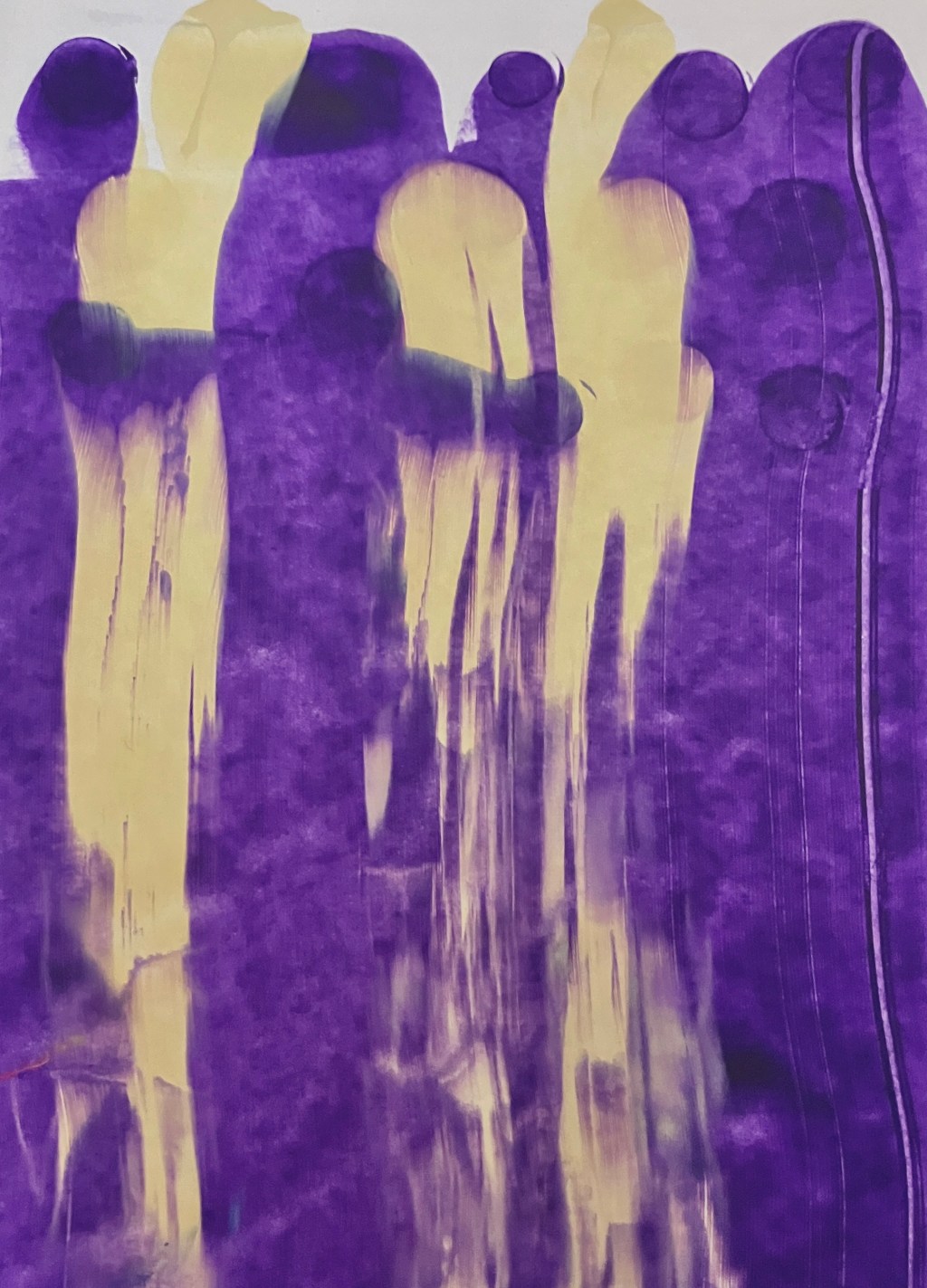
Artwork Source: untitled, Cyrus Carlson
Artist Statement: My small abstract paintings are typically 4”x6.” Bright and joyful they command small moment of attention in a distracted world
Cyrus Carlson is an abstract painter from the Midwest.
 The Turning Leaf Journal