
Wrong Fruit
By Christina Lee
I haven’t been able to eat anything since I arrived in Seoul, which is unusual, and I wonder if I
am sick. I am nauseous for the fifth day in a row and on the third day, my 할머니, my
grandmother, takes me to see the pharmacist for an anti-nausea medicine, which comes in a
small, matchstick sized box. The medicine appears to be a handful of bitter, herbal-smelling
pellets. Maybe I would have mistaken them for wild blueberries if not for the smell. The
pharmacist instructs me to take them all at once so I swallow them down.
I am still nauseous.
It is a day before my flight back to New York and I am seated at my grandmother’s dining table,
watching her peel away at the fragrant skins of multiple 한라봉, mandarin oranges from Jeju
Island. They are my favorite fruit, and still, I cannot eat.
I offer to help peel the 한라봉, of course, but my grandmother waves away my hands. Whether
she rejects my advances from guilt at our recent conversation, or because she is participating in a
centuries long tradition of a Korean elder peeling and slicing fruit for their child — an often
loving act of service, but a shoddy replacement for an apology, really— I am unsure. I do not
long for cut fruit from my grandmother, I do not wish for her to spill the liquid acid into the
crevices of her fingers at my expense.
I have been visiting with her almost a week now, and these last two days of my trip are filled
with more conversation than we’ve had in my entire lifetime. As a child, I have seen her only
rarely, when she has visited my family in the states or when I have occasionally made my way to
Korea on a family trip, but we have never been alone together. Maybe she feels emboldened by
my curiosity at my mothers’s childhood, as we had spent the last day flipping through my
mother’s baby photos together. Maybe she has been curious for a lifetime, and this is the first
opportunity we have had to face each other.
We are sitting across the dining table again and my grandmother suddenly asks, gripping my
hands, what her daughter was really like as a mother. She wears concern on her face. I feel the
warmth in her fingers as I attempt to collect my thoughts and sort through my haze of memories.
How do I explain this in a language I feel elementary at? I understand more than I can speak, and
I simply do not have the vocabulary most of the time. She has more than suspicions, she
explains, from when she visited my family once and witnessed, horrified, my mother dragging
me out of my chair. For what reason, neither of us could remember anymore. It doesn’t matter
why she did it, of course.
Why I am so curious to see my mother’s childhood photos during this visit, I’m not sure. The
very thought of her fills me with dread because of the years of abuse she had put my body and
mind through. But seeing these photos also reminds me that she was innocent once and that she too, was somebody’s child, once. My grandmother points to a photo of my mother as a young
child, remarking, “She was so small then. And frail too. She could’ve blown away in the wind, so
her teachers would walk her home from school.”
I confirm my grandmother’s suspicions about her daughter, while she confirms mine. I suspect
that my mother, too, has experienced something terrible in her childhood. I know that she has
learned behavior from somewhere, and that she has inherited the understanding that the kind of
treatment she extends to me is acceptable, from someone. Hours later, my grandfather comes home from a meeting with a friend, and my grandmother demands that he apologize to me, for what he wrought onto my mother and which she wrought onto me. This is the first time I hear the word “apologize,” used in Korean. No one has ever apologized to me before— not in this language. The context tells me that what I am hearing is ‘apologize,’ but I translate it on an app to make sure what I am hearing is correct, that I am not
misunderstanding. I need to be sure, so I can commit this to memory.
I notice that in Korean, the word for apology, 사과, is the same word for “apple.” Such a simple
word has evaded me for 24 years.
Despite my grandmother’s insistence, my grandfather does not apologize. For an hour, he
excuses his abuse with tales from the Korean military. He regales me with the violence that they
were required to enact and witness, as if I might care for excuses by someone who willingly
became violent towards his own family and also his people. One only has to look to the history
of Korea in the 50s through 80s to know the deadly roles the military played in coups and against
democratic uprisings, as led by America.
Though I learn the word for apologize, I do not receive an apology that day. I do not hear it again
for years, and I recognize it the next time, with certainty.
The next day, my grandparents drive me to the airport and I pass through security with the bag of
한라봉 slices in hand. Once I am on the plane, still 12 hours from New York, the nausea finally
lifts and I eat all of them in one sitting. I eat insatiably, as if I do not know when my next meal
may be, and I peel away at the piths to reach the fruit inside. As I place each slice in my mouth,
the juice runs down my fingers, leaving them sticky. I do not dare slide my way past my already
sleeping seat-mate to go and wash my coated hands. I sit, contemplating, instead. Despite having
finally eaten, I feel strangely empty still.
Christina Lee (she/they) is a disabled and chronically ill Korean writer, rester, fiber arts hobbyist, researcher, nervous system, tangerine-eating machine. She is hibernating on Lenape land (Brooklyn) with her partner and senior dog. She writes about caring a lot, eldest daughter musings, and staying a living, breathing human. You can find her on Substack, or on Instagram @thepainquotidien.
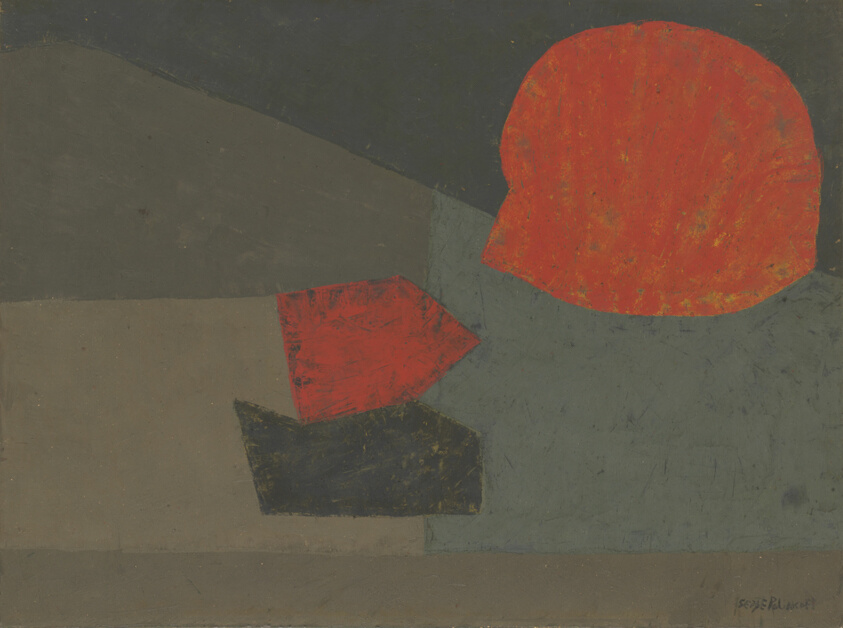
Artwork Source: “Composition,” Serge Poliakoff. From the Public Domain.
 The Turning Leaf Journal