
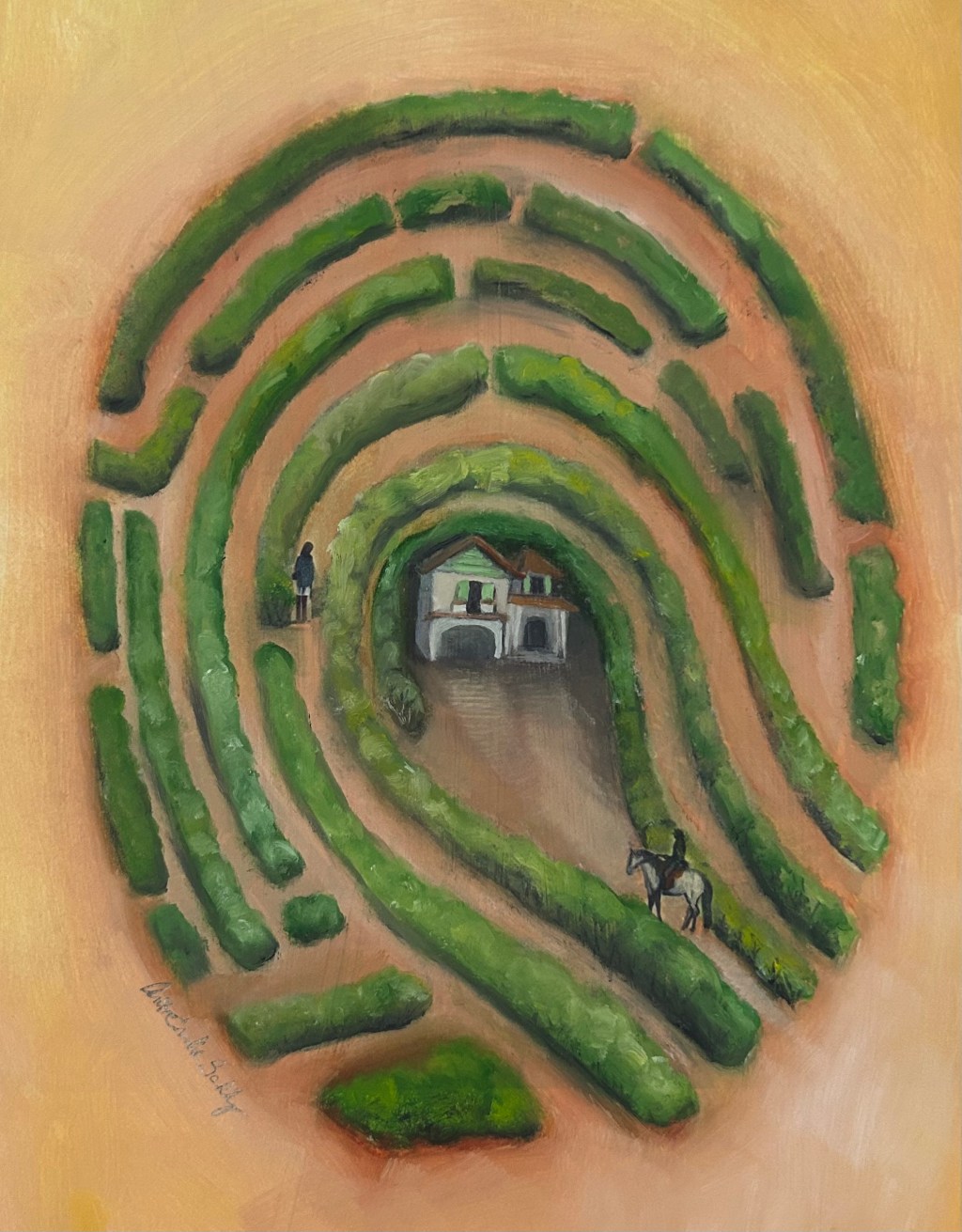
In a Labyrinth, Time is Suspended
By Nancy L. Penrose
What pushes me to walk my labyrinth of Laos? Winding paths—on the page, in person, in the folds of my brain—where divisions disappear, where memories decades apart rub shoulders. What has propelled me to return four times, adult pilgrim to a once-foreign land that was home to me, a young girl from Oregon, in the 1960s? Perhaps it is the long-buried grief from having left my beloved Lao pony. Perhaps it is my friend, Somdid, who has molded my returns into homecomings.
The labyrinth is an ancient mystical tool that can provide pathways to discovery, transformations of the spirit. Many years ago in Chartres I entered the cathedral’s eight-hundred-year-old labyrinth. Its shape is a circle divided by quadrants incised with the twists and turns of paths that are organic, like the whorls of a fingerprint, the loops of an intestine, the convolutions of a brain. Walking in bare feet, I felt the mystery and power through blocks of stone set into the floor of the nave.
A labyrinth is not a maze; it has no dead ends, no tricks, no cul-de-sacs. There is a unicursal path that leads to the center and back out again. Like writing, a labyrinth can nurture the pattern-seeking, intuitive parts of our brains.
The Walk In
My mother, father, and I entered life in Laos when we landed in Vientiane on December 14, 1962. I find this date in my childhood diary, a chunky little crimson book with gilt-edged pages. My first entry, written in tiny cursive script: Well, we have arrived in Laos (at last). Our house is really very nice. I am very tired and very anxious for tomorrow. Second day, December 15: Today I have made lots of friends and I like them all very much. This is what counts in the life of a nine-year-old child.
For my parents, George and Lynn Penrose, our time in Vientiane was rife with uncertainty. There was no job ready for my dad when we arrived. He was an expert in agriculture, hired by the United States Agency for International Development (USAID) during the Kennedy administration to help save Laos from communism.
While we were in limbo, I followed the paths and made the turns typical of American children in Vientiane whose parents believed they were working toward noble ends even as they were cogs in the machine of American imperialism. Our house—provided by USAID—was in the American compound of Leeville. I attended birthday parties and pool parties with other American children. I joined a fourth-grade class at the American school. I went shopping with my mother at the American commissary where she bought cans of sterilized milk (no fresh milk to be had), Nestlé Quik® (to make canned milk tempting), white flour and yeast for baking bread, Almond Joy® candy bars that tasted of mildew. And a white plastic Christmas tree that seemed exotic compared to the fresh green firs at home in Tigard, Oregon. I learned how to say sabaidee, hello, to the Lao children who waved at me as I rode the USAID van to school. With a new friend of my mother’s, Doro Belinsky, I took a ride to the morning market in a bicycle rickshaw, a samlo. She bought me a fresh coconut and I gorged on the juicy white flesh. That night I was sick, vomiting. Was it the coconut? Maybe. Tropical Laos was rich with bacteria unknown to our North American stomachs.
Finally, after four months, my father was assigned a position in the southern provincial capital of Pakse, which we learned to pronounce as pawksay. There, where the Sedone River joins the Mekong, my life changed again. In Vientiane I had been a sheltered and shielded chauffeured child living among other Americans. Pakse brought the shock of classes in French at the local Lycée, a teacher who spoke no English, Lao friends at school, life in a two-story house set next to a village of wooden houses on stilts. And massive freedom on the back of my pony, for not long after we arrived in Pakse my father bought me a little horse.
Dun colored. Black mane and tail. Black legs. Black stripe that ran down his back. Brown eyes. Rubbery gray nostrils that quivered when he nickered a greeting to me. Sweet dusty horsey smell when I brushed him. Mongolian stock, small enough for me to easily climb on and ride, not like the big horses on the farm back home in Oregon. I named him Fahong, the Lao word for thunder.
I study a snapshot of me taken in 1963. Sitting atop my pony, I am wearing a white tee shirt and denim jeans, and I am grinning. His ears are tilted back as if listening to me. His coat is glossy, shiny, healthy. All these years later I still find him beautiful.
We are posed in front of our Pakse house: white stucco with mint-green trim, jade-green wooden shutters that could be closed against the monsoon rains, there being no glass in the windows, only lime-green plastic screens to protect against insects. The house sat near an empty field where I often tethered Fahong after riding him along the orange-dirt road that led to the path above the Mekong where, within the shade of banana and palm and starfruit trees, we watched fishermen perform a delicate ballet, balancing on the prows of their pirogues before casting their nets in unison. And if it was the dry season Fahong and I would make our way home along the borders of dried-out rice paddies filled with straw-colored stubble from the last harvest. We knew to avoid the big gray water buffalo with wide black horns whose favorite wallowing pond had mostly dried up and so he could be hot and grumpy and dangerous, just one type of pony hazard with another being poisonous snakes, which was why I tried to tether Fahong away from thickets of brush. Even so I once found him near a krait, flattened and dead, and I imagined him stomping it with his black hooves, powerful despite no shoes like our horses back home.
My parents set boundaries for my rambles on Fahong: the road into town, the road next to the airport, the two rivers. I am astonished at the freedom I had. I once asked them about this and they said, We trusted your riding skills. We trusted the Lao people. And so at the age psychologists say is at the heart of building identity separate from family, of developing mastery of the world, I was granted control of my pony and my piece of the universe.
After each ride, I curried and brushed Fahong. One time, moving around behind him as my father had taught me—one hand on his rump and staying in close—his hind foot flashed out with no warning and he kicked me hard for no reason. I remember the hoof-shaped bruise on my upper thigh that was at first blue and purple before fading with time to yellow and green, though it took much longer for my heart to heal from the hurt that my beloved pony had kicked me.
Was that kick before or after I almost killed him with love? I don’t recall, but one day I rewarded him with an abundance of his favorite snack after our maid, Praim, handed out from the kitchen door a big bunch of overripe bananas and I fed them to Fahong one after another, cooed to him and petted his nose as his rubbery lips gummed them out of my flat outstretched palm. Several hours later my father, the farm boy from Oregon who knew animals, noticed my pony’s lethargy and I spoke of the banana feast. Recognizing the danger, dad said we must keep Fahong in motion, must not let him lie down, must keep the bananas moving through his stomach, horses being incapable of vomiting, regurgitating. So we walked him in circles around the courtyard all night long, taking turns leading him. Finally he lifted his tail and dropped manure. We had saved him, but I see now the near miss of a disastrous turn in my childhood.
In August 1964 my mother and I left Laos. Sixth grade in Tigard’s Phil Lewis Elementary School awaited me. My father stayed to finish his two-year contract. I had no choice but to leave Fahong. There was no way to bring him home. I had known that from the beginning.
Because of the guerrilla wars in 1960s Laos, planes were the safest way to travel and we used them often. Each time we took off from Pakse—on trips to Vientiane or Bangkok or to Hong Kong for vacations—I rehearsed the pain of leaving Fahong. I imagined hugging his neck for the last time, whispering goodbye in his ear. Yet I have no memory of our final farewell. Have I blanked it out because it was so painful? Did my parents keep me too busy and distracted to feel sad? Certainly I was diverted by returning home and being the oddball kid in an American classroom after my life in Laos. But what happened to Fahong? I don’t remember what my parents told me.
Many Lao ponies led hard lives pulling heavy wooden carts. They were skinny with ribs that stuck out. Their coats were dull. Their skin was pocked with open sores from chafe of harness and shaft. Did my father have Fahong shot? He would have considered it an act of kindness to prevent a life of pain for my little horse. I know my parents would have hidden that from me. But why, why do I not recall what they did tell me? I never thought to ask them when they were alive.
Today I see my blanks as clues to my buried grief, not just at leaving Fahong, but also at leaving Pakse, for with the final closing of the airplane door my childhood world of Laos was gone.
The Center
After leaving Laos, I stood in the center of my labyrinth of memories for nearly thirty years. I finished grade school, junior high, high school in Tigard. I rode our big Oregon horses, my boundaries defined by barbed-wire fence and cedar forest. With my father’s help I raised Suffolk sheep, showed them at county and state fairs as my 4-H project.
I went to Oregon State University, got my first jobs, met and married David Muerdter in Rhode Island, had a baby, Claire, in New Orleans, then moved back to the Pacific Northwest, Seattle. In 1990, David’s job as a geophysicist took us to live in Singapore. There I picked up a brochure about tours to Laos, now renamed Lao People’s Democratic Republic by the Pathet Lao communists who took power in ’75 after years of war and revolution. Going back had been impossible for so long that it was a dream I didn’t know I had. Studying the photos of golden temples, green tropical forests, meandering rivers, I felt as if I were tumbling into the images, a vertigo triggered by waves of the familiar. When I calculated that Laos was only a few hours by plane from Singapore via Bangkok, I began to plot my pilgrimage into memory, my walk out from the center.
My first day back in Lao PDR was January 19, 1993. I was traveling with Sandy and Jan, friends from Singapore. That night, in my room in a Soviet-era hotel in Vientiane, I dreamt I reached the end of a road and turned around.
The Walk Out
But that was not the true beginning of my walk out. No. That happened a few days later when we flew into Pakse, the place that had been the heart of my childhood life in Laos. As the plane made a turn over the Mekong and descended to the landing strip, I knew we were flying low over our house, if it still existed. As a child, the roar of planes was sometimes so loud, so close, I felt I could reach up and touch their silver bellies from my bedroom window on the second floor.
Waiting on the tarmac was our government-required guide arranged by Diethelm Travel. We shook hands, shared names. Somdid Somphonxay had an open and friendly face, a relaxed and welcoming manner, black hair, a crisp white shirt and dark pants. He was of average height for a Lao man, which meant that I, a red-haired woman six feet in height, was several inches taller.
Grasping our stack of blue passports stuffed with the flimsy white papers of our travel passes, Somdid led us to a man in green fatigues and black combat boots who was perched on a stool behind a wooden stand set up outside the ramshackle terminal that looked unchanged from thirty years before.
I was impatient to connect with my past. During the shuffle of official papers and the thud of rubber stamps, I tugged out my wad of photos and said to Somdid, I lived in Pakse as a child. Can you help me find my house?
Surprise rippled across his face as he took the photos and studied them closely. I said we had lived near the airport not far from the Mekong. He nodded, opened the doors to the waiting Jeep, and gestured for us to climb in.
And with that I began my walk out of the labyrinth, that terrain of remembrance and dreaming made concrete with rediscovery. We find the house I lived in as a child and the generator shed out back that my father had converted to a barn for Fahong. We are even invited into the house and I see again the stairs I came down one morning to find my parents huddled over the shortwave radio listening to the news on Voice of America that President Kennedy had been shot and killed in Dallas. And then, outside, we meet an old woman—teeth stained blood red from chewing betel—who lives in the village next door. Through Somdid she says she remembers me, the happy girl on her horse, how my father gave her water and my mother gave her food. I grasp her hands and burble through tears, kop chai lai lai, kop chai lai lai, thank you, thank you. As my feelings spill and flow, Somdid gently leads us back to the car and we drive to the edge of the river. My breathing slows, my tears cease as we stroll the path where I used to ride Fahong.
The next day Somdid takes us to the center of town and we visit the buildings that were our Lycée, ours because he went there too but we did not know each other then, and the day after that we travel up the rutted and slow orange-dirt road to the cool air of the Bolaven Plateau where I remember a Frenchman who grew strawberries, les fraises, and the next day we take a boat down the Mekong to the town of Champasak to walk among the ancient Khmer temples of Wat Phu.
These places come to form the pattern of all my returns: the one three years later in ’96 with my sister, Jean; the one in 2011 with David; 2015 with David and Claire. Somdid is always the centerpiece. Somdid is always there to say, Welcome to your hometown.
For many pilgrims the walk out of the labyrinth clarifies patterns, melds that which has been learned on the walk in with the time spent in the center. On my visits back to Pakse—accompanied by Somdid and nurtured by the loving interest of friends, sister, husband, daughter—memories from the 1960s join those from trips made decades later.
In the years of my returns, the airport morphed from ramshackle to sparkling international terminal with flights from Siem Reap. Somdid built three hotels in Pakse by combining hard work with what he’d learned as a tour guide, by melding his l’Université de Montpellier degree in business with construction savvy. His first hotel was Champa Residence near the stadium on the outskirts of town where Jean and I stayed in ’96. The afternoon before we left for Thailand to return to the U.S., Somdid drove us to the edge of the Mekong and parked so we looked out to the water. He pushed in a cassette tape and, as the voice of a woman sang Rose de Pakse, he told us his dream of building a hotel beside the river.
And on my next trip back, many years later in 2011 with David, we were Somdid’s guests in that hotel, Mekong Paradise Resort, and he gave us the best room with the broad red-tiled patio that looked out to the river, north to the new bridge built with Japanese aid money, across to the thickly forested green slopes of Phou Malong spiked by the golden spires of a newly built temple complex. At the end of his busy days, usually as David and I were finishing dinner on the terrace, he often appeared with three glasses and the bottle of Cognac we had gifted him and he poured each of us a glass of amber. We spoke of his children—Sidaphone, Phetsamai, and Sompet—grown now from when I first met them in 1993, educated in Australia but back home again, each running one of his businesses, for Pakse is his hometown and he wanted his children to have a way to make a living there for it is also his wife’s hometown, the woman he had promised to marry when he went off to university in France, the woman he returned to wed and who is a steadfast and wise partner in his endeavors, whose given name is Boualamphone, but whom we always call Madame. And though I already had roots in Pakse, they were shallow compared to Somdid’s, born and raised there, yet his dedication to our friendship meant I could graft my little roots onto his and, with his help, grow Pakse again into my hometown.
During our visits we hear stories of the years of the American war in Southeast Asia when the U.S. dropped more than two million tons of bombs on Laos, of how Somdid and Madame asked each other every day if they should stay or go and they decided to stay even as siblings and cousins and friends fled Laos, of how Somdid’s mother passed away while his father, a military man who had worked with the Americans in the 1960s, was sent to a re-education camp up north after the Communists took power in ’75.
On my first trip back Somdid asked me, What can you do for Laos? and my answer was to write about the Laos I knew. Not that the action felt adequate, but it was something. And then, after my second visit, he asked if he could send his children to me in Seattle for their education. Such a big ask. I, already overwhelmed by a job and a child in grade school and a husband who traveled for work, I, who had chosen to have just one child and was terrified by the task of nurturing three Lao children far from home, I said no. Happily there was another woman, another traveler, who had gotten to know his family, an Australian named Julie, who said yes.
On my most recent trip, the one with David and Claire, we sat talking after breakfast one morning with Somdid and Madame in the open-air dining room of Mekong Paradise where a breeze off the river swayed the hanging pots filled with sprays of little purple-and-white orchids. Claire asked me a question: How did your family get water when you lived in Pakse? Back then the town had no public water system, so I told her of the USAID tanker truck that came when summoned to pump river water up into the tall metal holding tank that stood behind our house. From there gravity fed water into our faucets, bathtubs, toilets.
I warmed to my topic, memories flowing back now: drinking water was made safe through boiling then a disinfectant added then a pass through cylinders of ceramic candle filters set into the bottom of tall cream-colored pots of stoneware. My mother and Praim scrubbed the filters frequently to remove the accumulations of reddish orange river sediment. A little silver tap at the bottom of the pots was what I opened to draw a glass of clean safe water. Cold water was filtered water stored in repurposed gin bottles lying on their sides in the refrigerator. At the end of my musing explanation, there was a quiet comment from Somdid: I had to go to the river to bathe. Only I heard it and that’s all he said, but it felt like a slap, a slap I deserved. To escape the embarrassment that swelled up in me, I changed the subject. But now, revisiting that memory, I wish I had asked how his family had gotten their water. Did they boil and filter it to make it safe, or were their bodies strong enough, accustomed enough to drink it untreated? I see how unaware I was of my privilege, my self-centeredness, not only as the little American girl in the 1960s, but also as the adult woman returning to Lao PDR decades later. I had not considered how different Somdid’s childhood had been from mine, how different the childhoods of my classmates at the Lycée, even though they were the offspring of privileged Lao families with fathers who were government and military officials. It speaks to Somdid’s kindness and generosity that this was the only time he drew a contrast between our lives, our histories. I take solace that he once told me it was a lucky day when he was assigned to be my tour guide on that first trip back in ’93.
He and I have stayed in touch through the years via the communications technology du jour, first faxes, letters, international phone calls. Then emails, What’s App, and now Facebook where I follow him and his daughters. Every year, in mid April, Somdid sends me birthday greetings via Messenger and I wish him and his family a happy and healthy Py Mai, Lao New Year.
I don’t know if I will return again to Pakse, but I will continue to walk the winding paths of memory. After dredging up my childhood grief, after bolstering my roots in Laos, I may find there is more to uncover. In a labyrinth, time is suspended.
Nancy L. Penrose (she/her) is co-author of A Dream and a Chisel: Louisiana Sculptor Angela Gregory in Paris, 1925-1928, published by the University of South Carolina Press. Her essays have appeared in Catamaran, Orange Blossom Review; The Ekphrastic Review; Shenandoah; the collections of Travelers’ Tales; and the anthology Burning Bright: Passager Celebrates 21 Years. Her publications have been nominated for the Pushcart Prize and for Best of the Net. More details may be found on her website.
Artwork Commissioned from Anita Eralie Schley.
Anita Eralie Schley graduated from the University of Utah in 1996 with BFA in Studio Art. In addition to having her work in a multitude of galleries and publications, she has also taught art through continuing education classes, an Alternative high school drawing class in Box Elder County, the college setting as an alternative photography processes substitute at Salt Lake Community College and was the photography program director for CLASS Art School. Anita is both a painter and a photographer and enjoys exploring different mediums in her artwork. She has received multiple awards throughout her career including most recently: Honorable Mention 2023 for the Workshop13 exhibit RED, Award of Merit 2022 Utah Women Artists Exhibit, Best of Show 2020 Box Elder Museum Photography group exhibit. She lives in Springville, Utah with her husband. She has four adult children and recently became a grandmother for the first time.
 The Turning Leaf Journal