
Ekphrasis from Picture to Process: A Review of Ama Codjoe’s Bluest Nude
By Kira Rosemarie
In Bluest Nude, Ama Codjoe pulls the reader through the work as if following a brushstroke along a canvas. Each turn of the paint is grounded in a new type of imagery, from the familiar and familial of “Two Girls Bathing” to the speculative ekphrasis in “Detail from ‘Poem After Betye Saar’s The Liberation of Aunt Jemima’” to the descriptions of nature in “Slow Drag with Branches of Pine,” Codjoe places footholds not by referencing what has been referenced intimately, but by continually introducing new ways of seeing the intimate. This focus on building new views for the reader as she traverses the collection is why I see Codjoe’s ekphrastic pieces as the standout works of Bluest Nude.
At its heart, the ekphrastic style is a conversation primarily between two artists and secondarily among the two artists and the reader/viewer. Codjoe sparks these conversations with multiple approaches to the style: relational, speculative, and process-based.
In “Posing Nude,” Codjoe anchors her poem with the artwork “Living Room, Brownsville, Brooklyn” by Deana Lawson. She uses the photograph as a jumping-off-point to show how the visual relates to her own experience with an ex-lover:
               This particular ex anticipated
               my needs like a photographer considers
               sources of light.
Detail from “Detail from ‘Poem After Betye Saar’s The Liberation of Aunt Jemima’” takes a different approach: speculative. Codjoe uses this poem to speculate what’s next in the scene presented by Saar’s work, and builds a surreal world on top of the already-rich image:
               And out of her gushing head, I witnessed
               four fully-grown women spring forth
               like winged beasts
The process-based ekphrastic poems interested me the most when considering the conversation among the two artists and the reader/viewer. By naming the process, Codjoe invites readers to not only consider the art alongside her writing, but also the process of actually making the art and how that impacts the effect of the works together.
In “Aubade (after Romare Bearden’s Patchwork Quilt (1969),” the speaker states
               I’m standing
               in the middle of a room constructed
               with pencil, adhesive, and paper.
This places the speaker and the reader in the physical artwork itself, not just the ideas the artwork represents.
In “Poem After an Iteration of a Painting by Lynette Yiadom-Boakye, Destroyed by the Artist Herself,” Codjoe directly describes Yiadom-Boakye’s process: “Instead of re-priming / the canvas, she reduces it to 2 X 2 ½ meter / pieces.”
And in “Le Sacre du printemps (after Pina Bausch),” Codjoe points not to a visual artwork but to a choreographed dance and how it affects her:
               Tonight, I remember
               I vowed to feel as alive as the woman
               who, in a rite of spring, must dance herself
               to death.
Codjoe’s various approaches to ekphrasis, combined with the arresting and surreal imagery she creates throughout the collection, create a uniquely harmonious work that made me feel as if I were present for moments of the speaker’s emotional ponderings, clarified by a curatorial eye yet unfiltered by oppressive shame or propriety.
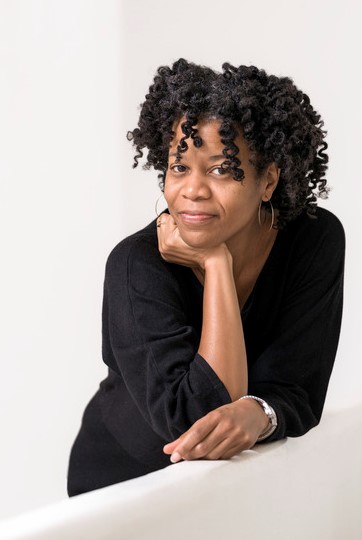
Ama Codjoe is the author of Bluest Nude (Milkweed Editions, 2022), winner of the Lenore Marshall Poetry Prize, and finalist for the NAACP Image Award for Outstanding Poetry, the Kate Tufts Discovery Award, and the Paterson Poetry Prize; and Blood of the Air (Northwestern University Press, 2020), winner of the Drinking Gourd Chapbook Poetry Prize. In 2023, Codjoe was appointed as the second Poet-in-Residence at the Guggenheim Museum. She is the winner of a 2023 Whiting Award and a recipient of a 2024 Arts and Letters Award in Literature from the American Academy of Arts and Letters.
Kira Rosemarie is an artist and writer living in South Florida with her husband, her cat Duchess, and her dog Marchesa. Her work has been published in La Piccioletta Barca, 805 Lit+ Art, The Write Launch, and others. Her debut chapbook, “Moon/Season,” was published by Bottlecap Press in 2022. On her Substack, she interviews witchy creatives in a feature she calls “The Fang.” Follow Kira on Instagram @busy_witch.
More from Summer 2025
 The Turning Leaf Journal
You must be logged in to post a comment.