When reviewing artwork submissions, we look for pieces that reveal something about the artist and/or the subjects they’re exploring. Susan’s evocative work tells a clear story while leaving room for the viewer to see themself within the work, which is why we included four of her pieces in Volume 1, Issue 2–including the issue cover. These collages, formed from found materials, explore themes of identity, connection, and transformation. As we’ve gotten to know Susan better, we’ve discovered that Susan’s vibrancy extends far beyond just her artwork–everything she touches is infused with life and love.
In this interview, conducted asynchronously in June 2025, Susan opens up about her creative process, what’s inspiring her, and how being a visual artist and poet go hand-in-hand.
::
How would you describe your art to someone who has never seen it before?
I create abstract pieces of visual art on canvas from found materials to convey a mood or message primarily through the use of color. I mainly use scraps of paper torn from magazines or catalogues although I often incorporate ephemera and other forms of text (vintage book pages, blue prints, postage stamps, etc.) and sometimes add elements of ink, paint and pencil.
In three words I would say: kinesthetic, textural, color-driven. Wait, is that four words?
One of my favorite quotes about writing, from an essay by Rosemarie Waldrop, applies to what I am hoping to explore in my visual art as well: “Collage, like fragmentation, allows you to frustrate the expectation of continuity, of step-by-step-linearity. And if the fields you juxtapose are different enough there are sparks from the edges.”
I am very excited by the idea of bringing forth those “sparks from the edges.”
We know you for your collage work. Do you work in any other mediums? Are there mediums you’d like to experiment in, but haven’t yet?
I have done some work in water color and lately I have been working with acrylic ink. The only formal training I have in art is a 6-week watercolor class I took at a local arts center. I took an online course on color theory through the Guggenheim earlier this year, which gave me great insight into how much I don’t know.
I have also recently discovered pastels. I admired Jesse Kercheval’s work in her 2024 graphic memoir The French Girl, and ordered a set of pastels so I could try them out. My gray pastel disappeared within a couple days of me opening the set and I am hoping my dog didn’t eat it! I have been watching a lot of beginner pastels videos on YouTube and experimenting with them and other media as part of an Index Card a Day art challenge.
I spent a lot of time earlier this summer trying to create this impossible imaginary shade of pink I have in my mind. The table in my studio is covered with about 50 index cards covered in various hues of pink! I still haven’t gotten it but I will keep you posted!
Since I deleted all my Zuckerberg apps in November 2024, I miss the connections I had with other visual artists on IG the most. I try to participate with the arts community on Bluesky.
In your artist statements you reference some of the magazines you source collage material from. How do you choose elements of these magazines to cut out?
For my collage pieces, I separate the processes of “gathering” materials from sources and the “assembling” into art into two different distinct steps.
Gathering: I will spend an hour or two going through magazines and catalogues looking mostly for colors but also text and shape that inspire me. It’s very interesting because while I’m doing this “hunting for color” I can’t listen to a podcast or even music. I get into some kind of zone. It’s a very good feeling. I use scissors but I like the effect of torn edges so I also tear strips.
Assembling: When I am creating the actual pieces, I work from a number of cardboard boxes into which I have sorted the scraps. So that is my palette, I guess. I used to keep them all in labeled bins organized by color but I found having random colors juxtaposed in the same bin can lead to exciting results. I work on canvas, mixed media paper and book board, the inside covers of discarded old books.
What, to you, is the value of creating art? Do you create art for yourself first, or do you imagine an audience when creating (is it always the same)?
Most of the time I think I am creating art to make something to connect with other people. For me, beauty is a primary concern (in both my poetry and art), but also loneliness. There is a hope of making someone else feel slightly less alone. Even if that someone is me.
On the value of creating art, I think this passage on Vincent Van Gogh, from Brenda Upland’s 1937 book, If You Want to Write, comes close to describing what my “creative impulse” might be: “If you read the letters of the painter Vincent van Gogh you will see what his creative impulse was. It was just this. He loved something, the sky, say. He loved human beings. He wanted to show human beings how wonderful the sky was so he painted it for them. That was all there is to it. … He looked out his window at a watery twilight, a thin lamppost, a star and he said in his letter something like this: It is so beautiful I must show you how it looks. And then on his cheap ruled notepaper he made the most beautiful, tender little drawing of it.”
Have you always been an artist? How has your relationship to creating artwork changed over time?
I have always been creative. I was brought up in an environment in which beauty and the arts were something to be valued, for which I am grateful. For some reason(s) I never really allowed myself the investment in time and resources to seriously explore visual art and poetry until I became disabled and unable to “work” in 2020. I was lucky enough at that time to find a supportive group of local poets and artists who were and are extremely generous with their knowledge and attention and love of learning. We have been meeting on Wednesdays on Zoom for five years now.
You’re also a poet! How does being an artist inform your work as a creative writer, or vice versa? Do you look for intersections between these mediums?
I started this creativity-focused era of my life (late!) by immersing myself in the world of poetry in 2020. I signed up for the free international online ModPo class through UPenn and was fortunate to have that amazing and focused community to formally introduce me to that realm. At that same time, I found myself no longer able to work as a physical therapist due to chronic illness. (I have Crohn’s Disease and Ankylosing Spondylitis which are related and incurable auto-immune conditions.) Keep in mind, this was also the first year of the pandemic, which we mustn’t pretend didn’t happen, so there was a lot going on in my life!
Anyway, I started working on a project engaging with my college Gray’s Anatomy textbook as a source text, trying to extract “found poetry” from paragraphs of the very dry technical language you would expect from an anatomy textbook. It was challenging and satisfying at the same time. I was using ink and colored pencil to add contrast and to help emphasize the text.
Looking back, I can see that I was searching for a way to integrate my changing identity from a health care provider/ professional to a new identity as a disabled individual and poet/artist. Of course I had no idea at the time! I gradually started adding collage elements to some of these visual/found poems, like in my pieces published in Red Ogre Review.
Naturally, this lead to me jumping straight into creating collage. So yes, my poetry and visual art definitely inform each other, especially considering my gravitation towards working in two different art forms that explore the use of found materials. Also, again, going back to this idea of “sparks at the edges”. You can think of this as it relates to color or shape or line in visual art, but also how it might relate to line breaks, contradictory ideas, surprising syntax or juxtaposition of unexpected images in poetry.
Do you begin a new piece with a vision, or do you just start piecing things together and wait to see what happens?
With collage I begin with a vision and then…end up with something completely different. There is something to be said for losing yourself in the process and the joy of allowing yourself to become immersed in the doing itself and letting go of any plan you might have had, so that you can really respond to what you are laying down, even if it means covering up that really cool image of a rusty tricycle that you originally planned on highlighting. I guess this might apply to writing poems as well.
I keep a quote from Mary Ruefle, (Madness, Rack & Honey) near my writing desk, “I would rather wonder than know.” I think this might be a good place to come from when approaching any creative endeavor.
Are there any artists or writers living rent-free in your head? What about them captivates you?
Chen Chen is a poet I really admire and turn to often. There is something very tender about his work that I am drawn to. He doesn’t shy away from humor and joy and he is somehow able to make me laugh and tear up in a single poem, sometimes in a single line. I feel very invited and included by his work. Another writer I really admire is Diane Seuss. Her work is very generative for me in that when I read her, I am inspired to write—immediately and frantically! She seems to be such a generous literary citizen as well. I find a kind of nourishment in the quiet and steady poetry of Linda Gregg. Her essay The Art of Finding is one I find myself re-reading on a regular basis. Her thoughts on artists having “resonant sources” which forever influence and inform their work is fascinating to me. I also return again and again to both the book and the audio recordings of the lectures by Rachel Zucker comprising The Poetics of Wrongness.
As far as visual artists, I am drawn to the work of a contemporary collage artist named Robert Voights. He uses a lot of vertical lines in his work and I have the same tendency. I have a weird obsession with painter Ellsworth Kelly. Vermeer was probably the first artist I really was captivated by. One of my daughters lives in DC so I try to stop in the National Gallery of Art to see his work in person when I am there. For free! This year I read three separate poetry collections (by Lauren Camp, Brian Teare and Victoria Chang) all informed by the work of the artist Agnes Martin. Another favorite is Estonian textile artist Anu Raud(Bird Song is one of my favorite works). The book Hotel Almighty by Sarah J. Sloat, a visual poet/artist, engages with the hybrid type of collage/ found poetry work that really interests me. Earlier this year, I saw a mural in Philly of a young Black woman in a mustard-colored hat against a bright teal background that took my breath away, by artist Amy Sherard. She has an exhibition at The Whtiney Museum right now I am hoping to see. Philadelphia as a city itself is a great inspiration for art. So many murals, and art installations and street art. I find it very invigorating to be there. StreetsDept.com is a great resource for Philadelphia’s Public Art scene.
Do you often find inspiration from other artists/writers? How do you know when you’ve been inspired?
Yes. I have a practice of reading one poetry collection a week for the past few years. Shout out to the Public Library! I have written and published many “after poems” where something I have read has inspired me to write something in response. I find comfort and company in the words of other poets, both those from long ago and contemporary writers. Ekphrastic poetry has a long tradition and I enjoy engaging with that type of work. Obviously, I’m also interested in flipping that to make works of visual art inspired by poetry.
What projects are you working on right now (art, writing, or beyond)? Or do you have any projects you’re planning?
I have two poetry chapbooks out for consideration for publication. I have come close several times, but no luck getting it picked up yet. I have entered some of my collages in a two art shows this summer, which is a leap for me, as I have only recently been able to describe myself as a visual artist. I am also working on a series of poems considering my Estonian heritage. My mother was born on a small island off the coast of Estonia. I was fortunate to be able to make a trip there in 2018 but I need to go back. The Estonian National Museum in Tartu was impressive and endlessly fascinating and honestly, I would like to spend a week wandering around inside. Kind of like an Estonian version of The Mixed-up Files of Mrs. Basil E. Frankweiler.
One genre I would love to explore is graphic memoir/essay. I recently bought the book Field Guide to Graphic Literature, edited by Kelcey Ervick and Tom Hart. These all sound like very exciting avenues to explore.
What advice do you have for other creatives (artists, writers, etc.)?
I think I might be too new an artist to offer much advice, but maybe for other newer artists, I would offer this: Try to make it a priority to regularly spend time to talk and learn about art with other creative people, who take their work (but not necessarily themselves!) seriously. I have found this consistent dedicated and scheduled time to be invaluable for my growth as an artist.
I would also say immerse yourself in art of any kind whenever you can. In her book The Artist’s Way, Julia Cameron emphasizes the importance of “artists dates.” I am a big believer in those. And spending time in solitude and silence. Which is hard to do.
::
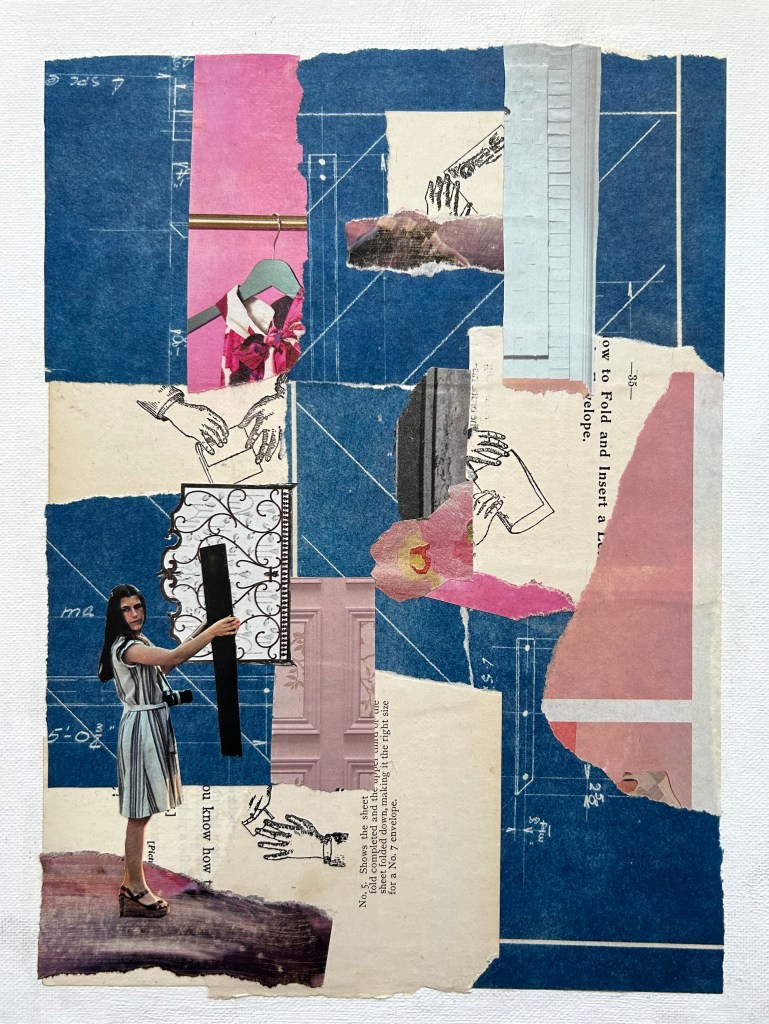
This section of the interview pertains particularly to “I’m Trying to Decide if this is What I want,” the title of which originates from Linda Gregg’s poem “Highway 90.” This piece was published in Volume 1, Issue 2 of The Turning Leaf Journal.
Which came first: the title, or the artwork? How did they find each other?
For me, a poem came first. I wrote a golden shovel based on that same line from Highway 90:
               To Tonawanda from New York on the I-90
                                                           —after Linda Gregg’s Highway 90

               A woman, who is me, is driving west. I’m
               going back to the river again, trying
               to remember how it is that I came from it. To
               reconcile the disconnect, decide

               how I’m related to the flowing chunks of ice, to discover if
               there is anything left in this
               flat landscape for me to excavate. Is
               there dirt to be brushed from these sharp fragments? What

               pulls me back is not the tide. I
               was fresh-water birthed. This swift current feeds a fathomless want.
If you read down the end words of each line you will see that it is the same line that I used for the title of that collage, “I am trying to decide if this is what I want.”
I think that line resonates with me so much because I have gone through so much change in the past few years. And also, as I have gotten older, I started to realize how for much of my life I seemed to not necessarily be making decisions or choices but more or less going along with what I had internalized was the expected or the “normal” life path. I think at this point in my life I want to be more intentional in my choices and with my time and give myself full permission to be kind of a weirdo, since I think that is my natural state.
To us, this piece speaks to the conflict between the urge to fit in with social constructs of femininity versus authentic expression of feminine identities. What does this piece mean to you?
Yes. Being a woman in this culture is complicated. We often are judging ourselves, and for me at least, I find myself asking am I doing it right? I know other women writers and artists my age who say they are so much more at ease, but I haven’t gotten there yet.
The inclusion of blue prints and the vintage book page, where little bits of illustrations of hands demonstrating how to make an envelope are visible, speak to instructions and expectations that we receive. The pink flowers and hints of floral-patterned clothing speak to a softer more expected idea of feminine identity. And the woman figure (from a 1970s National Geographic) seems to be trying to construct something genuine and authentic but she isn’t sure how it would look based on her lived experience and examples. For me this piece engages with the questions “What kind of life do I want to build for myself in this present time and culture? Can I explore both femininity and masculinity? Does it have to be one or another? Is it even so binary?”
How long did you work on this piece/what was the process like? What challenges did you face?
I have a habit of working on a piece of visual art obsessively until its “done”. You can ask my husband (haha). So probably it took about 6 hours (including preparing the canvas and applying a couple layers of thin varnish afterwards to protect it) but in a very compacted time frame. I found the blue prints from a water treatment plant in Hudson NY stamped December 29, 1948 at an antique store upstate and I loved the intricate white lines contrasted against that rich shade of blue. The technical difficulties I had were getting the adhesive to work for the blueprint since it is much thicker than the usual paper I work with.
Do you feel like this piece is a fair representation of the work you typically make?
I think it is a fair representation of some of my earlier works. I have collected a lot more source material over the past two years, so I tend to use more color and shape and form at present. Also, I’ve learned I am happier with both the process and the result, when I allow myself to be surprised by the process, to respond more to what I am laying down, rather than working from a predetermined plan. Sometimes a collage, like a poem, despite best efforts, doesn’t “work” and that is OK. Well, usually that’s OK.
::
We’re interested in themes of change here at TTLJ. What changes have you experienced lately, and how/have they influenced your work?
I have experienced significant personal grief over the past year, as well as grief for the planet and the country. It is pervading my poetry and visual art even when I try to reach toward something lighter. Because I am always searching for answers and am sometimes stubbornly convinced I can find them in a book, I have read many, many books on grief in the last year. My favorites: The Wild Edge of Sorrow by Francis Weller. I underlined so many passages in that book, including this quote, “Sorrow is the sustained note in the song of being alive.” So good. Also equally loved and was devastated by Edward Hirch’s 2014 masterpiece on grief, Gabriel.
How do you define change?
Change can be a verb or a noun, it can mean to alter or modify, or it can be a substitution. Or a transformation, or the way oak leaves turn to gold in the fall. It can be a coin you keep in your pocket or an extra outfit in the back seat of your car, just in case. It can be the break in a voice as it deepens with time, or the sudden dizzying change of life at midlife, a switch in the mind. It could be great, as in a sea change, or ordinary, in as a lane on the parkway. It can be a swap or a negligible additional amount or an afternoon thunder storm that finally breaks the humidity in July. Or a specific type of pitch in baseball. On one hand, some things never change but on the other hand, everything changes. Change is when something is not what it was.
Is there anything you think folks tend to misunderstand about change?
I think that it is inevitable, as much as we like to cling to the past. It’s one of those lessons that most of us have to keep relearning over and over. When I first got sick, I kept trying any new cure or method I would come across and expending so much time and energy trying to get “back to the way I was”. It took five years for me to realize that was never going to happen. I guess acceptance is key, but you can’t just intellectually come to that conclusion. It takes time and mistakes and errors and missteps and falling back into old unhelpful habits and re-learning and re-remembering what you thought you already learned. But on the other side is more empathy for others and hopefully self-compassion too. And there can be an opportunity for shedding of some of those old roles and expectations and norms that can be liberating.
Is there anything you wish you could change? (about your life, the world, publishing, or anything). What would the impact of that change be, for you personally?
Such a big question! One thing I would like to see is for people to remember that we are born to be deeply connected to the earth. We are animal. I wish we would view ourselves as part of nature rather than separate from it–that realization would propel us to take better care of the planet. And maybe even each other.
We believe it’s important to source and share our good news. Is there anything you’ve been celebrating recently?
I have an artist website now that my daughter helped me design. The homepage photo features an image of the sea I took when we were visiting the island where my mother was born in Estonia.
What can you tell us about your background?
I come from Tonawanda, a small river town in western New York, just north of Buffalo. Tonawanda means swift running water in the language of the Iroquois. I am very drawn to and connected to rivers. Right now, I’m listening to an episode of my favorite podcast (Between the Covers, with David Naimon) featuring Robert Macfarlane talking about his new book, Is A River Alive? (To which I would answer with a resounding yes!)
I grew up as one of seven children in a big old ivy-covered stucco house with stained-glass windows and French doors and cherry wood molding which was both beautiful and completely falling apart. My father was a newspaper man and my mother went back to college when I was in high school to finish her degree and became a librarian. There were a lot of books in our house!
I graduated from Ithaca College and worked as a Physical Therapist in hospitals and outpatient clinics and even as a health care coordinator for an order of Catholic nuns. Since I became disabled in 2020, I have grown to consider myself a working poet/artist. Walking is part of my process, the movement and rhythm helps me “write’ in my mind, so on the days that I can walk I go into the woods. I try to read every day in the morning. I have way too many books. I am trying to declutter and donate them to our library’s Book Barn, but sometimes I’m sure I buy some of them back by accident.
I live in a lake neighborhood in the Hudson Valley region of New York with my husband and our 13-year-old dog Willow. My three adult children live in San Jose, DC and Philly. I miss them the most on their birthdays.
Final Thoughts:
Life is hard right now. Make sure you listen to your favorite songs, loud and on repeat! Dance with your dog and your cat! Ignore their judgmental looks!
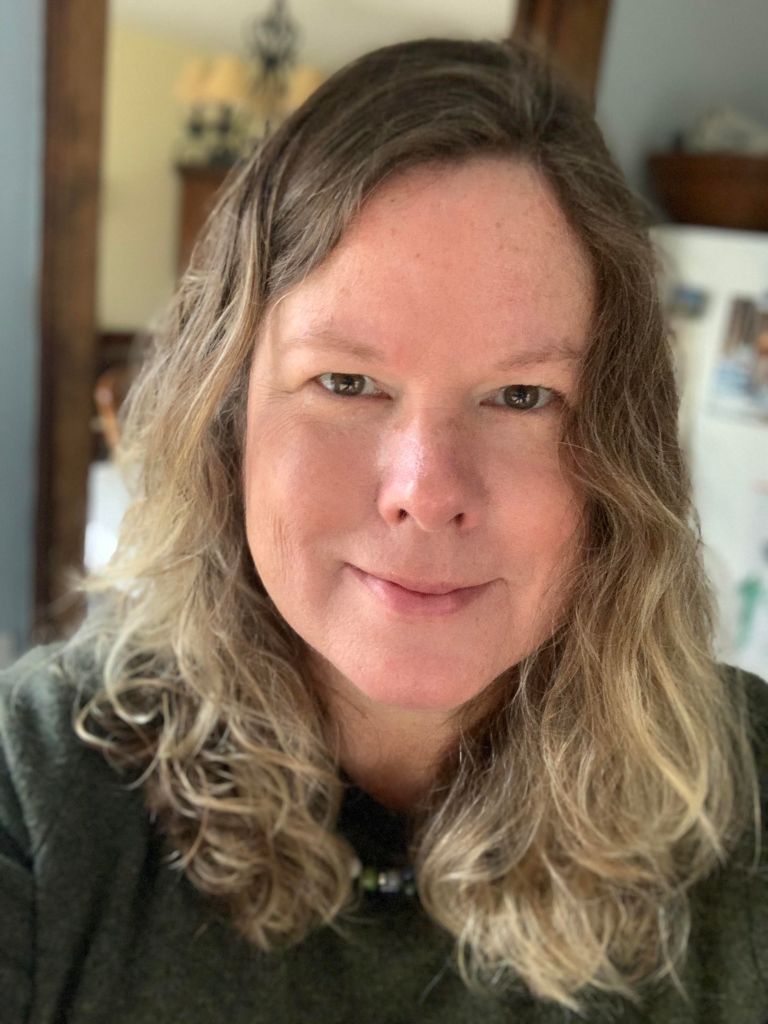
Susan Barry-Schulz (she/hers) is a first generation Estonian-American poet and visual artist who grew up just outside of Buffalo, NY. Her work has been nominated for multiple Pushcart Prizes and Best of the Net awards and has appeared in The Westchester Review, Rust & Moth, SoFLoPoJO, and in many other print and online journals and anthologies. You can find her on BlueSky at @susanbarryschulz.com or find out more about her work at www.susanbarryschulz.com
More from Summer 2025
 The Turning Leaf Journal
You must be logged in to post a comment.