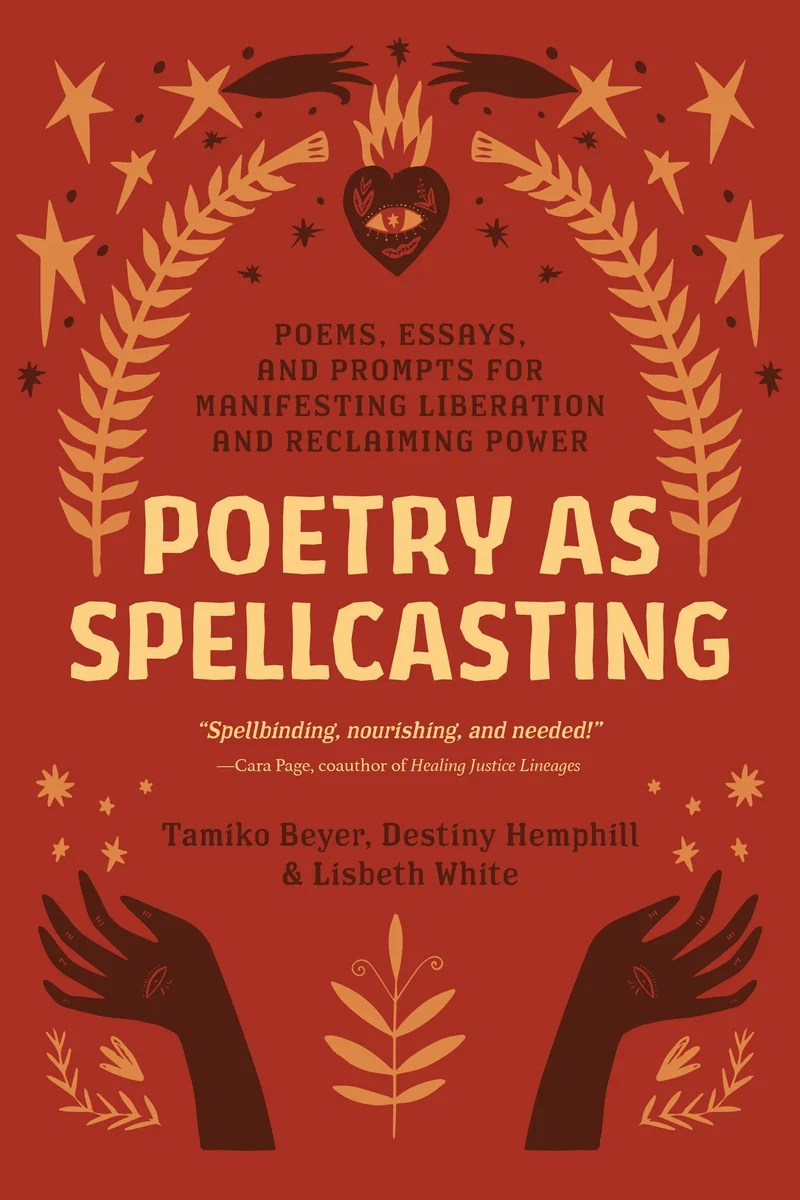
A Review of Poetry as Spellcasting: Poems, Essays, and Prompts for Manifesting Liberation and Reclaiming Power
By Kira Rosemarie
The language of a spell, from ancient pagan hymns to medieval mixes of old encantations and the Bible to modern charms for luck and beauty, is meant specifically to hold and focus power. In Poetry as Spellcasting: Poems, Essays, and Prompts for Manifesting Liberation and Reclaiming Power, Tamiko Beyer, Destiny Hemphill, and Lisbeth White emphasize the importance of this power and how it can support and uplift marginalized communities.
As both a poet and a practicing witch, I have an obvious bias toward this book. However, I believe it has something for every writer, especially those who may be spiritually inclined but aren’t sure how they can use those feelings to influence or integrate into their work.
n the introduction, the editors remind us that “both poetry and spellcasting exist and play in the spaces closest to this mystery,” referring to the “moments of opening or surrender to an energy that feels beyond the personal ego—a something mighty and unnamed.”
Kenji C. Liu mirrors this in the essay “Text of Bliss: Heaping Disruption at the Level of Language,” when he says that “if a sign and a signifier are not a relationship but a single thing, then to use a word is to actually conjure and activate what it refers to. To write poetry is to cast a spell.” To me, these statements encapsulate this collection.
Fourteen contributors, including the three editors, have built a collection that not only explores this power but also gives the reader opportunities to claim it themselves through prompts and rituals. Each of the eight sections includes one of these exercises, and each is a pathway to a deeply moving and magic connection with writing and oneself.
The first prompt, “Ritual for Setting a Space,” gives simple instructions on setting up an altar and setting aside dedicated space for writing. As Dominique Matti says in “Articulating the Undercurrent,” “poetry, for me, is an essence-making process.” A ritual space creates a portal for this essence-making to begin.
The works then explore healing, imagination, freedom, and community. “How do poems heal?” Sun Yung Shin asks in the essay “A Korean Orphan Undergoes Catholic Training for Future Poets.” The answer: “By binding us to our own insignificance, and by that, reminding us of the embodiment of our oneness with everything in our universe.” “We are,” she says, “both sacrifice and altar.”
If you read this book, you will feel the depth of these statements in your bones. You don’t need to have any experience with spells or witchcraft before reading. Poetry as Spellcasting brings you into ritual work with ease, and weaves those rituals into social justice just as smoothly. You will be left with feelings of power and hope, best summed up by the last several lines of Hyejung Kook’s poem “prayer for healing:”
when you listen
may you hear
what you need
to heal
to live
to die
with joy
Poetry as Spellcasting was published by North Atlantic Books in 2023. Edited by Tamiko Beyer, Destiny Hemphill, and Lisbeth White, the collection contains essay, poems, and prompts written from Queer & BIPOC perspectives in an effort to reclaim presence in a field historically dominated by white, cishet writers.
Kira Rosemarie is an artist and writer living in South Florida with her husband, her cat Duchess, and her dog Marchesa. Her work has been published in La Piccioletta Barca, 805 Lit+ Art, The Write Launch, and others. Her debut chapbook, “Moon/Season,” was published by Bottlecap Press in 2022. On her Substack, she interviews witchy creatives in a feature she calls “The Fang.” Follow Kira on Instagram @busy_witch.
More from Fall 2025
 The Turning Leaf Journal
You must be logged in to post a comment.