
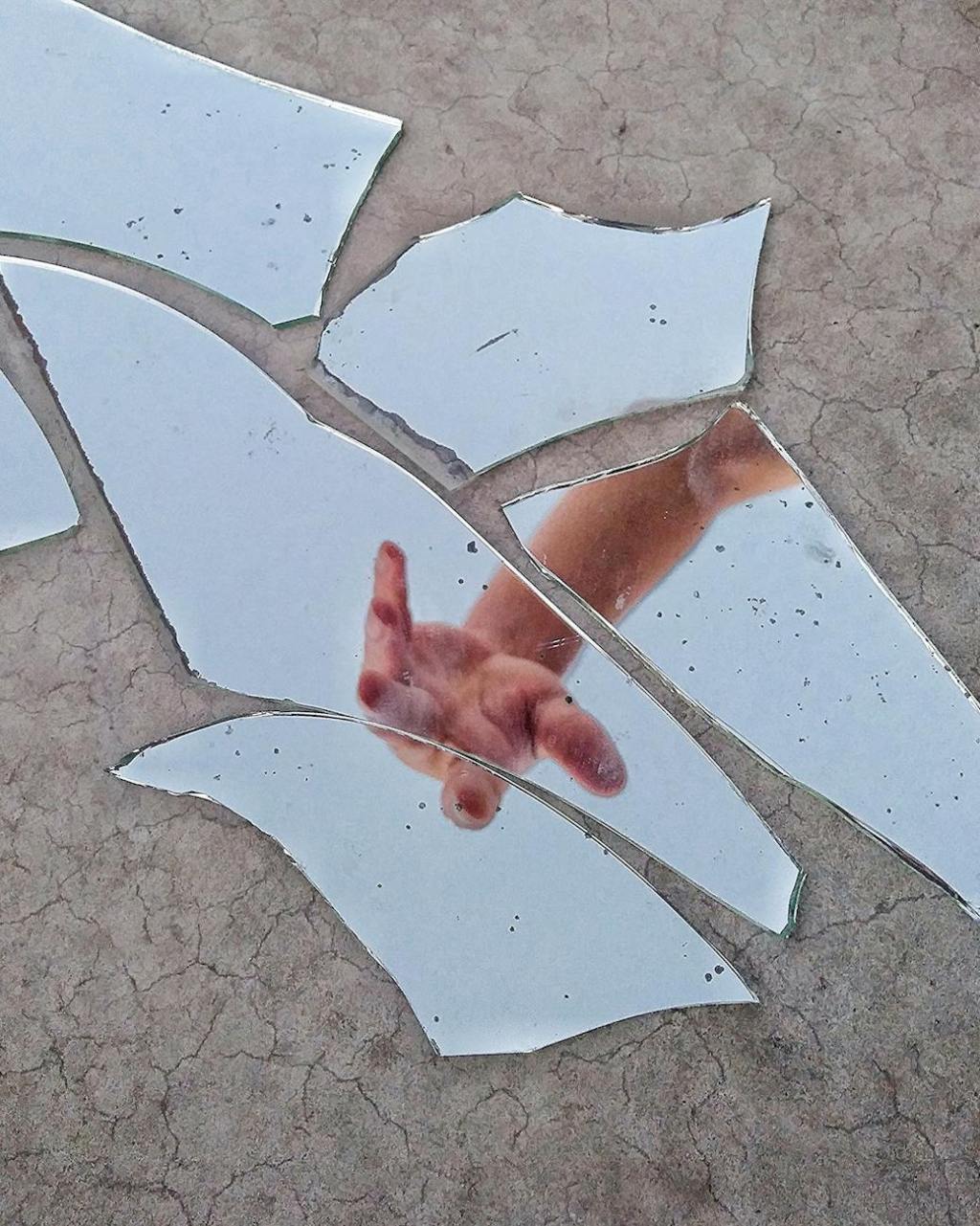
All Apologies
By Isobel Bradshaw
- A glass breaks. Tips over the edge of the counter—
- —and shatters, merlot seeping between the floorboards.
- —and lands perfectly in the sink, splintering into dozens of pieces, the carnage contained.
- —and you catch it, but not before it gets chipped on the corner of the granite. The chip cuts your finger; you bleed.
- What do you do?
- Apologize to the air around you for daring to inhale it, to sully it with your wine-soaked breath, to displace it with a drunk’s body.
- Apologize to the glass you’ll have to throw away, yet another victim of your carelessness.
- Apologize to the cut skin. Continue treating your body as an entity separate from you, so you don’t have to claim responsibility for its mistakes.
- When you’ve had your fill, when the scratches have multiplied beyond counting, give up and go to sleep—
- —in the bedroom. Curl up under the sheets and wake to find them stained red. Spend too long trying to remember what caused it.
- —on the couch. No doors to open or stairs to climb, just floral upholstery yellowed with age and the scent of spilled beer.
- —on the bathroom floor, several convenient receptacles for vomiting into within easy reach. Don’t bother trying to bandage your fingers; they’ll only bleed again when you remove the dressing.
- The door opens in the morning. Back from the night shift, your—
- partner.
- spouse.
- roommate you’ve sworn for years you’ll be able to afford to live without, who foots more than their fair share of the rent and then Venmos you for a Diet Coke from the drive-thru.
- What do you do?
- Apologize for the mess in the kitchen. Allow yourself to cry a little, for dramatic effect. Ignore the way your mouth still tastes like wine.
- Apologize for falling asleep so quickly, for slurring your speech on the phone, for the incomprehensible, barely-conscious texts.
- Apologize for your trainwreck of a brain, your liquor-saturated synapses. (Become a little defensive afterwards—it’s not your fault if that’s the only way they’ll function.)
- Your partner/spouse/roommate doesn’t want to listen anymore. You have a problem, they tell you, and it needs to stop. They complain about—
- —the broken glass in the sink.
- —the blood on the sheets.
- —the vomit on the toilet seat.
- What do you do?
- Apologize.
- Apologize.
- Apologize.
- Pull yourself together.
- Take the bottles of wine from the fridge and pour them down the sink, rinse them to recycle. Don’t buy any more. Avoid the liquor aisle when you get groceries.
- Start leaving the house more often. Go on a walk—a run, if you’re feeling daring. Drink the fresh air instead; it’s better for your liver.
- Cry about it. (Let yourself cry about it.) Bemoan the unlinear path. Think constantly, at first, about the parts of hell you miss. Consider jumping back off the cliff.
- You glue the pieces of yourself back together. Sooner or later, they come unglued.
- A little slip. A visit to the bar, a mocktail with less mock than you intended.
- One empty glass after another.
- This time, you might be able to stop yourself.
- What do you do?
Isobel Bradshaw (she/they) is a queer and disabled author of fiction and hybrid work. Her work has been longlisted in Write or Die’s inaugural fiction contest and nominated for a Genrepunk Award; she has also appeared in Tension Literary, Major 7th, and FLARE Magazine, among others, as well as in the anthology Between Queer Teeth from t’ART Press. She has a BFA in Creative Writing and lives in the Midwest with her partner and cats.
Artist Statement: Over the past year, I’ve been thinking a lot about how time may be linear, but recovery – from anything – is not, and the outline form is meant to convey that non-linearity. I was inspired partly by the choose-your-own-adventure genre, which also is and is not linear, and wanted this to read similarly: you could pick one option, so to speak, from each heading and still end up with something cohesive. In this way, the form also puts emphasis on personal choice. People in recovery are there because they choose to be, oftentimes over and over. What started as a rumination on a true event (I actually did knock a glass into the sink, where it broke, and I am in recovery myself) became something that I don’t think could have worked in any other format.
Artwork Source: “Mirror Fragments on Gray Surface With The Reflection Of A Person’s Hand,” Thiago Matos. Free use image.
 The Turning Leaf Journal