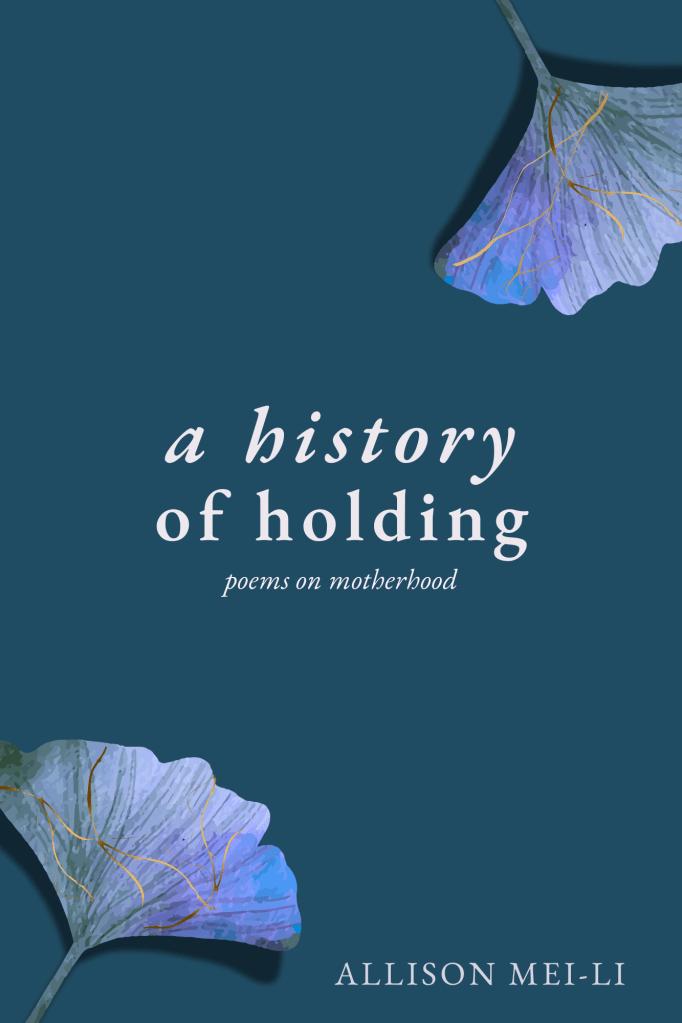
“My Baby Was Not the Only One Who Had Just Been Born:” The Making of a Mother in Allison Mei-Lei’s A History of Holding
By Bri Gearhart Staton
Once, in the wee morning hours when my son was six weeks old, I, sleep-deprived and wet with milk, woke to the realization that my baby was missing. Frantic, I overturned the bedsheets, felt his empty crib, looked underneath my bed, and finally, desperate, ran to check the bathroom, where the mirror’s reflection showed I had been holding my sleeping son over my left shoulder the entire time. I remember thinking that no one told me that the love I felt for my son would have to live among the anxiety and absolute wreckage of his arrival; life as I knew it as disrupted as the rumpled bedsheets and the constant ache of love in my heart matched only by the delirious question, “My god, what have I done?”
If my mother-self then had read Allison Mei-Li’s stunning debut poetry collection, A History of Holding, she would have wept in recognition. Here, Mei-Li makes room for the myriad and nuanced emotions of early motherhood. From the intense yearning amid fertility complications, the devastation of miscarriage, and the fear and excitement of pregnancy onward, Mei-Li pieces together an intimate mosaic of new motherhood with striking vulnerability. And while this collection centers parenting at its core, the poems within are marked with the tear-stained thumbprints of motherhood specifically, its societal inequities and unfairness balanced tenderly with deep insight and community care.
When reading poems about motherhood, there is something so compelling about the art of both seeing and being seen. Mei-Li has a gift for both, often centering the gravity of the poem in its final lines, leaving readers heartsick with recognition and eager for more. But the narrative strength of these pieces is deliberate from the very first lines, transporting readers to a darkened room lit only with the glow of a computer, a beach day with kelp crowns, and even a grief-filled trip to a mall Build-A-Bear. In centering readers in the specificity of time and place, Mei-Li really shines, but she also creates haunting liminal spaces where the “where” is deliciously nebulous. In “[Search History, III],” we see the manifestation of anxiety through search engine queries like “baby never sleeps,” paired with “how to feel safe in my body.” In “What the Nurse Said,” we experience the world that lives within the pause between two halves of a sentence. “Aftershock” features the internal seismic shift of a family of two becoming three.
And there’s room for levity here, too. In “The Fine Print,” a poem in the form of cheeky legalese, Mei-Li writes, “You may receive reminders from persons at the coffee shop that ‘It All Goes So Fast:’ however, the absence of such reminders does not permit the Mother to forget.” In “Texts I Almost Sent My Son Before I Remember He Doesn’t Have a Cell Phone,” the bubble reading, “Omg just saw a trash truck lol” made me laugh out loud. I, too, would have sent a text message not unlike that in my son’s earliest years.
And yet the most emotionally compelling moments in Mei-Li’s collection come from her tender recounting of conversations shared with her toddler son as he begins to navigate the world around him. “Lasterday” is masterful in showing how time can be abstract to both child and mother. In “The World Has Not Been Cruel to Him Yet,” we see how good and bad is defined through a child’s eyes side-by-side with his mother’s fear of an unaccepting world. And “Love Poem” thrusts us into the poignant tug of war of a child experiencing love while learning to define it.
Next month, my son turns fourteen, and I still feel such an affinity with the mother I was that night staring at my baby in the bathroom mirror, and with all the iterations of mother I once was and will be in the future. By allowing us a glimpse into the deeply raw and human moments that have defined her motherhood journey, Mei-Li shows us there is room for every single one of those reflections to be seen and held.

Allison Mei-Li is a writer and speech-language pathologist living in Southern California. She is the author of A History of Holding: Poems on Motherhood, a book that explores identity, the stories our bodies hold, and how it feels to be a human while raising one. Her work has appeared in anthologies, podcasts, and journals including Rust & Moth, MER Literary, and Sky Island, among others. When she’s not writing, she reads poetry submissions for The Turning Leaf Journal and designs tote bags and stickers for poets. Visit her at writtenbyallison.com or on social media @writtenbyallison.

Bri Gearhart Staton (she/her) is a poet living in southeastern South Dakota. A graduate of Augustana University’s psychology, theatre, and gender studies programs, Bri’s writing explores womanhood, identity, and experiences that exist in the periphery. Bri’s poetry has been published by Button Poetry, Page Gallery Journal, Wildscape, Livina Press, and in several anthologies. A mother of two, Bri’s objectively hilarious children are the joys of her heart. Connect with her on Instagram @bristaton.writes
 The Turning Leaf Journal
You must be logged in to post a comment.