Understanding Birdsong
By Eleni Vlachos
Nana unwrapped my gift, a book of bird photos, and cried. Still as an owl, she stared at the glossy pages of Indigo Bunting and Steller’s Jay. Tears streamed down her cheeks. Tears of relief, Mom guessed.
I used to mail Nana books with words. She no longer knew how to read them.
Before then, we would trade books. She flew through my college-assigned literature like The Fifth Child and Sula but her true love was mass-market fiction. When I took her to a John Saul reading at the University Bookstore, she approached his table tentatively to get her book signed and gazed at him with a reverence only reserved for Colin Firth (a minor crush; her Pride and Prejudice VHS tapes had warped from repeated views).
During my years at the University of Washington, we hung out a lot. A surprise, given our history. Starting with books, when she threw an encyclopedia at middle-school me. If I had known you would go to college and study, she said by way of apology, I wouldn’t have been so upset.
Nana—someone who wore clothes to bed as a girl to avoid being late to school the next morning—expected a certain level of attentiveness to scholarly pursuits. For reasons I still do not understand, I had stopped studying. Her mission was to help jump-start my interest. This mission began with a powerful testimonial: ‘Sakes, I always loved history. It culminated in flying objects including a crystal bowl; fortunately, neither of us broke.
Kids were never her thing. As a girl, my mom discovered she could see the back of her own head by holding up a mirror in front of another mirror. Nana replied: Everyone knows that! Her responses—variations of duh—spared no family member. As a girl I insisted the light remain on at bedtime, fearing supernatural forces in our old, creaky home. Nana’s eyes rolled higher than our haunted attic. There aren’t any ghosts! All children know denying ghostly existence makes them appear, of course, but Nana was unmoved.
Perhaps she did not envision her retirement including defiant grandchildren, or rather a defiant granddaughter. While I fretted about unsettled spirits, my brother slumbered in his room, a defunct kitchen in the Seattle duplex Nana and Papa bought in 1948. He slept with the soundlessness of the adored. He did what he was told, Nana explained to adult me. He studied.
He also never cursed Nana. Once at nine—mustering up the worst fate I could imagine—I shouted I wish there was gum in your eye! This kind of profanity could only be slung by a two-shoed member of the goody-two-shoes club. Still, it was deemed reckless enough for Papa, her husband-henchman, to start growling. Though he was not canine, I never questioned his strange warning sound. I ran upstairs to escape the inevitable spanking; surprisingly, I was still allowed to chew gum afterward.
Certainly, I was a troubled child. Oh, you had some odd friends, Nana said later. I suppose she was right; I gravitated toward strange and neglected souls. It is only now, in the joyful privacy of my own child-free home, that I realize what a sacrifice my grandparents made to help raise us after my parents’ divorce when I was four.
When I was ten, mom moved us from Seattle to California due in part to these gum-in-eye filled tensions. Mom was distraught by how much Nana and I fought, and wanted to give me a chance to flourish away from her rules. I, too, craved our independence and was eager to reinvent myself. I began cursing, quit violin, and made more odd friends. But after a year of four-plex life that included an untreated co-inhabitant who harassed other tenants and was dragged away by police several times, we decided being less independent back in Seattle was not so bad. Nana and Papa drove down to help us move our belongings back home.
However short, that move matured me, if only in my own imagination. I inched toward the person I would become. Rather than simply fighting with Nana, I tried to use humor. I was eleven, it was crude: unrelenting teasing, sketches exaggerating Nana’s authoritarian rule. We argued, but in a different key.
Still, Nana continued to dominate our lives. Someone once told me confident people wore bright colors, and Nana’s bold peacock display of floral blouses, turquoise slacks, and coral house dresses would corroborate. Her slash of cardinal-red lipstick warned all of potential undetained words; filters were for the birds. Mom and I gravitated toward earth tones, preferring to camouflage with the dirt. Young mom and her sister were embarrassed by Nana’s hot pink princess coat when they ventured out. Nana jabbed people out of her way on the bus; she never minded taking up space like we did.
Her loud polychrome matched her concept of personal noise management. As a child, I wanted to disappear into the rafters at my mom and Papa’s concerts when Nana belted the national anthem without regard for neighbor, pitch, or volume. Shopping at grocery stores I similarly pretended not to know her when she yelled DICK to Papa across aisles. WHERE ARE YOU.
::
After I moved to North Carolina, Nana—who had never traveled east of Minnesota—told mom about her “visit” to Russia. That trip began another journey, as Nana was slowly replaced with someone who washed her hair with hand lotion and cut her sandwich in half with scissors. When Nana addressed envelopes with phone numbers, mom took over the bills. This was how the disease progressed: Right tools, wrong place.
Deep into Nana’s forgetting I played a CD of birdsong, because she always loved birds, at least the deserving ones (no crows; she chased them away). As melodic tweets and timbres fluttered through the room, Nana paused to listen attentively, her mouth curved open in remembrance.
“I love this piece!” she said, as if it were Shostakovich, one of her favorite composers.
Nana always had preferred classical, a less strong way of suggesting other genres were not fit to call music. Back in college, when I dared play her “Landslide” by Fleetwood Mac, I expected her to be as taken as I. But her face soured.
“It would be better without singing.”
“Opera has singing.” I struck back, stung she dismissed the best part of the song. I ignored her signature eye-roll that need not entertain words.
Nana’s classical roots grew from her childhood as Gloria Cornish. Her father, adopted by the Cornish family from an orphanage, played in the Seattle Symphony and taught cello among other instruments. His aunt Nellie founded the Cornish College of the Arts nine years before Nana was born. Nana played cello in her father’s YMCA orchestra, where she met the violin and its player, Richard.
“And there he was,” she told me, giggling. “He lived at the Oddfellows Hall.”
“What did you first think about Papa?”
She paused. “Hmm.” Then she said: “Well, he was tall.”
True, Papa was six-foot-five. Sentimentality was never her forte.
In one sepia photo from that time—hand-colored by her mother Valencine no doubt—Nana sat upright holding her cello on their Craftsman porch. Her steady gaze and bow arm seemed to suggest a certain defiance, a fitting end to having slogged through the Depression wearing the same sweater every day. Her father cooked their pet rabbits for dinner and taught accordion to squeak by (for some reason, accordions paired well with trying times).
“He held his nose the entire time.” Nana laughed. “He hated the accordion.”
By the time I was born, arthritis had long since stopped Nana from holding down the cello strings. Her knotted hands instead wrote the names of family when I asked on the yellowed backs of photos, when she still had the who, where, and when. The photos prompted stories. Young adults in bonnets and Panama hats at a picnic; Nana and a stout woman standing next to Rhododendron bushes.
Nana pointed at the woman. “She made meatloaf from lentils and walnuts!”
“Ahead of her time,” I suggested.
“She was an odd bird.” Another eye-roll. “A vegetarian!”
One photo showed her standing by her in-laws and kids in El Paso, Texas, surrounded by the sparse desert xeriscape. Nana’s hands twisted my mother’s head toward the camera, while her other two children smiled off in different directions.
“Where’s Papa?”
“I left him.”
Papa struggled with alcoholism, and she was generally fed up. In her own innocent style, however, she temporarily fled to her in-laws rather than for parts unknown. She took the long train ride to Texas with her three children to stay with his parents. Rather than explain what led her to leave Papa temporarily or how that impacted her, the story she told repeatedly was one about her mother-in-law, Edna-Ethel. (A note—which may elicit a minor degree of sympathy for Edna-Ethel—she had a twin sister named Ethel-Edna.)
During the visit, Nana accompanied Edna-Ethel shopping. She shuddered telling me how Edna—a teacher of mostly Mexican children—refused to go into a store because a Mexican person ran it.
“A store with Mexican people? The horror!” Nana said with theatrical mockery. “From that day on, I hated her. I never liked anyone who was racist.”
Another picture showed her half-brother Tex whose mother, her father’s first wife, left before Nana was born. She ran off with a pianist to New York and left Tex behind. “My mother refused to raise him, so our father said he couldn’t live with us.”
Nana’s father was a kind man from all reports, but weak, succumbing to the stronger will of his second wife, Valencine, who notoriously made Nana call her every night.
“Tex always resented me,” Nana said, though they remained close and he joined us at family gatherings.
In another photo, a matronly figure sat in the driver’s seat of a Ford Model T glaring with an Out of my way face. Two-year old Nana stood on the running board with overalls and a bob-cut, held by Valencine.
“She used to back out of the driveway without looking,” Nana said of her grandmother Dotie, one of the rare women who drove in 1925.
Images drew us together.
Around age sixty—possibly coinciding with our one-year absence in California—Nana began to paint. Year after year, she painted cards and country scenes. When I went vegan after college, rather than requesting a walnut-lentil meatloaf, I asked Nana for a painting with animals. It was a strange request since I was no more into animals than trains or children, beyond not wanting them to suffer (the animals and children; to heck with the trains). She handed me a painting of random rabbits, cats, and geese dispersed. It was as if each were placed by space aliens who did not understand how they might relate. It was no Noah’s arc, which made sense because Nana was never the hugging type. Why would her animals cuddle?
Commercials were the closest Nana came to sentimentality, tearing up at ads. But like a foreign language, her love was open to interpretation. My favorite painting depicted a 1940s living room with soft golden tones and a cello propped in the corner by a piano, made for my aunt, her cellist daughter. Of course I could never fit into this scene. As a drummer, I sometimes felt guilty for not carrying on the more elegant family tradition of stringed instruments. My drums could never be as picturesque.
After I admired the painting, Nana secretly called her son, who had been a rock musician. Can you send me a picture of a drum set?
To my delight, she recreated the cello painting with a drum set in the forefront, adding my name on the kick drum.
It was prescient. Drums were in Nana’s future.
::
A few years before I moved, Nana turned eighty and her son composed and performed music with his sisters, myself, and my husband. After we finished our performance, Nana plopped herself behind my drum kit. It might have been the wine, but she hit the drums with a fierce joy, practically dancing. At her request, we began lessons. She came over and I taught her a classic rock beat.
Her lack of a drum set was a minor detail. She called me to her spare room to demonstrate her practice set-up like a good pupil. Pots on the desk, metal lids on the floor. She clanked the lids with her feet and smashed the pans with her drumsticks. She hated cooking, so this kitchenware rock was the most action these pans received. Arms stiff and precise, she pounded one-and-TWO-and-three-and-FOUR, singing the count then raising her sticks in a V Ta-da! followed by girlish laughter. She practiced often, eager to play music again in a surprisingly arthritis-friendly way.
Timpani were the only acceptable drums I heard as a kid at mom’s concerts, the kind that spoke only when spoken to at what seemed like random intervals. Nana embracing a drum kit felt like an acceptance. A hug for the underdog granddaughter and her inelegant instrument. Young me would never have anticipated Nana’s percussive joy or her supportive presence at my rock band’s shows.
She was an ideal audience member: Enthusiastic dance moves, loud shouts of approval after songs. Her jerky arm jabs discouraged proximity, but by then, I was proud of my brazen and unhinged grandmother. Since we fought constantly before I went to college, I later wondered: How had we become such close friends?
Now, as I attempt to describe this slow movement from combatants to companions, I grasp at clues to imagine our migration. My own memory falters. How does a relationship change over time? How do any of us grow or devolve through our moments and years, slow as bones? A relationship after all is a carrier for journeys, so I try to puzzle ours like the Ship of Theseus, asking at what moment we were no longer ourselves after we repaired and replaced all our parts.
I arrive at loose theories.
In high school, I worked at our local Safeway as a courtesy clerk. To my surprise, Nana joined me, getting a job in our bakery. We were on more even ground as co-workers. Her daily “specials” announcements were a highlight, since only an intercom could subdue her public brashness. Telltale crackling over the speakers signaled the start of her performance. First, a ten-second pause, then a few ahems and ums. Sometimes the sound of the phone being dropped. She would name several baked goods with verbal ellipses between them: Apple cobbler… em… banana…no…fresh bread…two-for-two, uh one, creshants…let’s see…
I do not believe Nana’s faltering intercom improv concerned her much. After all, she was a woman who called our state Warshington and always did the Warsh on weekends, but gave no indication of wanting to clean up her language.
My Papa died in 1995 when I became a studious undergrad and Nana had more alone time while mom worked. Apart from my love life—Another break-up?! Can’t you keep a man around?—Nana was proud of me for taking my college education seriously.
I began taking Nana on movie dates instead of these undeserving men. She never learned to drive, but was an expert. She provided many suggestions while holding on tightly to improve my operation of the car both moving (Watch out!) and stagnant when I parked blocks away on the street instead of using a garage (Just like my father, couldn’t squeeze a penny out of him!).
Nana was anything but quiet in the movie theater despite growing up during the silent movie era. She shouted at injustices on screen (How can they do that to her? RUN! Why don’t you run, you stupid woman?). I sank into my chair, embarrassed by her lack of theater voice. Afterward, we would eat at the Bamboo Garden and order the dish we called “chicken balls,” a sweet-and-sour plant-based meat of legend. Nana would try anything.
::
Right before Russia, Nana’s paintings of houses, birds, and seashores became blotchy and less precise. Fat brushstrokes slopped out beyond borders. Her style molted from Rockwell to Pollock. Nana sent me a card with a painting of my new house in North Carolina. Uneven diagonal lines suggested surreal 3D. The door, a brown blotch. Stabs of green hazily recollected bushes. A thin pencil sketch beneath the painted house faded like a forgotten memory. To our later shame, Mom and I asked her: What’s wrong, why can’t you paint like before?
Nana stopped painting. I can’t see that well, she said, and maybe this was also true. I later discovered the inability to reproduce shapes had a name: Constructional apraxia.
After I moved to North Carolina, I did not see Nana for almost three years. When I returned to visit, she introduced herself. She told me all about her daughter, my mother. I became a shape she could no longer access, and I went into another room and cried. Nana was still there, but I wasn’t.
Nothing hurt like being forgotten.
Drawing led to Nana’s diagnosis during this visit. “Draw ten past eleven,” the doctor instructed. Nana, a punctual woman with clocks in every room, confidently began her circle. Then, she stopped. She was unable to join the lines. Her clock hands, detached from their face, pointed to another dimension. Her numbers jumbled on the page randomly. Dali would rejoice at her time, splattered without meaning.
The doctor moved to the next task. “Write a sentence.”
Nana quickly scribbled: Some people think I’m nuts.
Here was the feisty Nana I loved, but it jarred me. Not remembering me did not mean she was unaware. There was still a person inside, wanting to be heard, fearful of judgement.
That night, I set up my drums and Korg keyboard next to Nana’s seat on the couch. I gave her maracas. She shook them and twisted side to side while I wrote a song named after her sentence, which later appeared on my band’s fourth studio album, Pockets. The song recalled her preference to “wake up happy” and disdain for anyone who did not. Maybe this is why Nana loved birds: Scientists discovered they sing so passionately in the morning because they can barely contain themselves after a night of silence. The morning light releases their restrained tension.
::
Nana became so docile it was hard to imagine her elbowing fellow passengers or shouting at me or anyone. The growing absence of Nana haunted me like the long-ago ghosts of my childhood, for the loss was not immediate and it held the mystical quality of a disappearing and reappearing act.
Music remained in memory after Nana forgot Mom, her daughter and caretaker. On her last Christmas, we watched the West Side Story and she conducted while singing her beloved songs. After the mega-crescendo of Tonight, she clapped fast as a hummingbird and yelled Whee! followed quietly by Oh…‘Scuse me! as if she surprised herself.
She turned her scrawny head to me. “I’ve heard it a thousand times but I love it.”
Much like work songs used throughout history to aid movement and relieve suffering, I activated Nana’s beloved tunes to help her move or relax. When doctor’s appointments scared her, I sang the West Side Story catalog and it flipped a switch. “I want to go to America!” I belted with the flair of someone auditioning on Broadway who would never get the part.
Nana shot me a fierce, challenging look. “Amer-EE-ca!”
“She’s so pretty…”
“Oh so PRETTY!”
When I helped her shower, I sang songs over her objections and she could not help but sing along.
My aunt read that Alzheimer’s often involved angry outbursts, so we were bracing for the worst. Strangely, Nana—who put the judge before mental, whether it was so-called loose women or wayward granddaughters—became more loving. I will never forget one such instance.
“I used to hate …” Nana began, then fell silent. “Hmm.” Her forefinger and thumb tapped together, a nervous habit she developed as the disease progressed. “Let’s see…which people was it I hate?”
I made some improbable suggestions. “Christian Scientists?” She had been one growing up.
“No…what are the north people called?”
“Canadians?”
“No…”
“People from Bellingham?”
The actual answer: Lots of people. Her run-of-the-mill hate included unruly children, drunk men, or people who got bored. Kids who did not study. She also hated positively, such as hating her racist neighbors, or rather their racism (they still gossiped and drank coffee together). She hated people who imprisoned Japanese families in internment camps, like her boss Dr. Yukio Kumasaka, who shared his firsthand experience while Nana was a nurse. Forgetting to hate was a bonus of Nana 2.0, as was her declaration of love for her late husband, my Papa. He was such a kind man. And he was. But I never heard Nana 1.0 say that.
Well into her forgetting I drove Nana to see Christmas lights. Gorgeous! she cooed effusively. I wondered if spacial changes in her brain led to something like a psychedelic trip. Some holiday decorations became bad trips like mom’s untenable collection of nutcracker men. Nana stared at the mantle of soldiers from her couch perch. All the little men over there… she whispered to me conspiratorially, darting her eyes around. Little men also stood around her bed, which she left in the wee hours to find mom. Mom gave her a rule. Nana repeated it to me like a kid sharing her homework: If it’s dark outside, stay in bed. If it’s light, get up.
Her taste for Boone’s Farm (pink flavor) remained. She drank so much I began watering it down. Once, I went too far, filling half her glass with water. She took one sip and practically spit it out. What is THIS? Her taste buds knew no dementia.
When I gave mom a few days off, Nana did not seem to notice. I became Mom. When mom returned, I was me again. We were interchangeable, but it didn’t matter. So I asked Nana: Who am I?
She paused and made some guesses. “Someone I know…” She looked to the ceiling as if for an answer, tapping her fingers together.
“But who am I to you?”
She searched my face. “Oh, I don’t know.” Then she brightened. “But you’re my family.”
Maybe this was all that mattered.
Nana has been gone for over a decade. Except, lately, she’s appeared: In my unruly self-ridiculing guffaws, gratuitously blurted opinions, and off-kilter dancing. I remember Nana when watching birds (perhaps an inevitable hallmark of aging), their sonatas our unreachable language.
Each summer, Clark’s Nutcrackers—known as the birds who never forget—stash tens of thousands of whitebark pine seeds in western forests. Come winter, they remember up to ten-thousand of their hiding spots. I read people with Alzheimer’s may forget the seeds planted earlier in their day that made them feel good or bad, but the mood of this planting lingers long after. How similar are we, the non-plaque-brained, when we feel melancholy but do not know the source?
To my Nana, birdsong became the Seattle Symphony, because the source no longer mattered: It was all music. Nana and I forgot we used to fight and became friends. Then, Nana forgot me. Love was as temporary as us. Over time, even the unflagging memory of the Clark’s Nutcracker fades and they leave uneaten seeds beneath the trees.
Though she lost most of her language eventually—Nana would say “Boom, boom, boom,” to denote speediness, for example—a surprising eloquence sometimes emerged.
“I never say something that isn’t true,” she said toward the end. “And when I say the truth, I cry.”
Then, Nana grabbed her watered-down glass of pink wine, and considered it passionately.
“Come to mama!” She cried, and drank it gone.
Eleni Vlachos is writing her first novel. Her fiction and non-fiction have appeared or are forthcoming in The New Republic, Turning Leaf Journal, Spotlong Review, Roi Fainéant Literary Press, The Marlowe Review, and others. Eleni also drums for an indie rock band. She was raised in Seattle and has grown older in Durham, New York City, and Philadelphia; she now resides in Athens, Greece. Her new craft series for bookworm writers is Reading Like a Writer and on Substack: https://substack.com/@elenidvlachos.
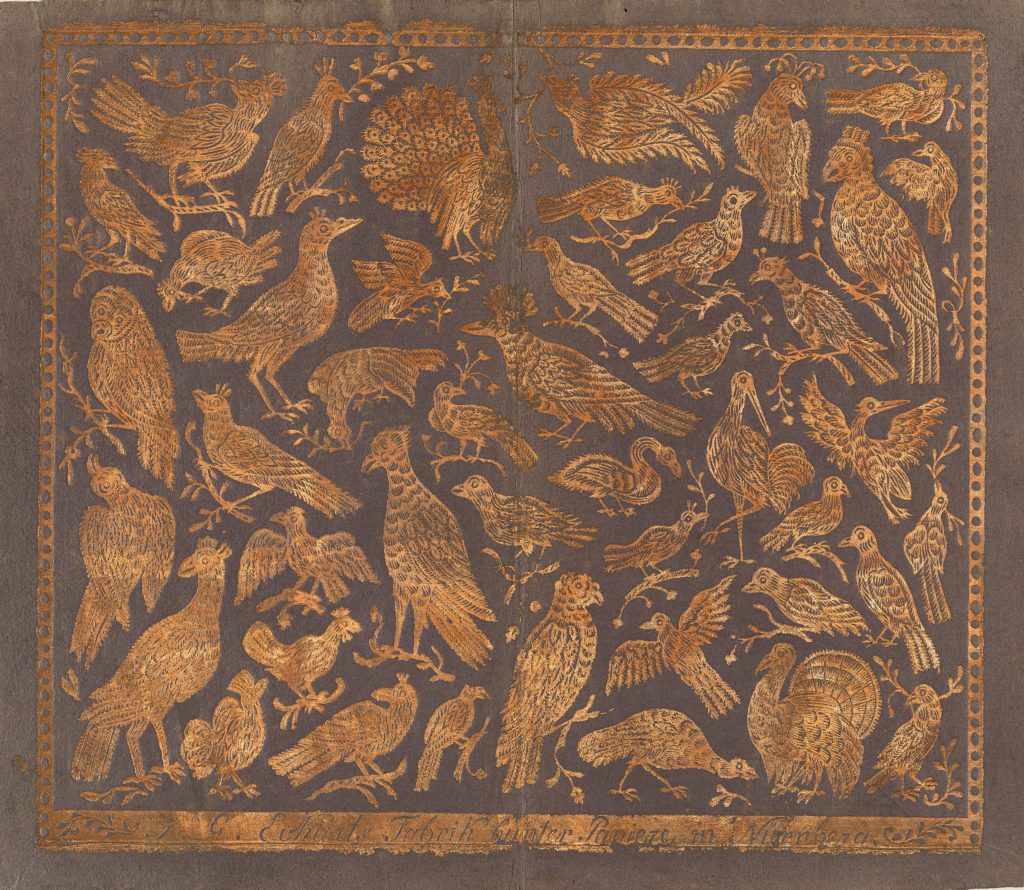
Artwork Source: “Endpaper with Birds,” by Johann Georg Eckart. From the Public Domain.
 turningleafjournal.com