On Conservation Conversation
By Faith Palermo
Microphone bouncing between both hands, a representative from PowerMan introduces the evening’s speaker. Paul Burgess, a retired engineer who had worked in water resource planning, had decided to travel 122 miles from Leeds to the Isle of Man to hold a community lecture focused on his assessment of climate change rhetoric. PowerMan, a community group dedicated to exposing the climate “truth” of the Isle, had requested that Burgess investigate the government’s plan to install wind turbines across the island. From behind the microphone, the representative smiles. She asks the audience to come to the conversation with an open mind, to act appropriately and seriously. For a moment, her smile falters. Recently, people have been attacking Burgess online. She appeals to pathos. “Paul is one of the most amiable, tolerant, and compassionate people I’ve ever met.” Yet despite this, the Internet had taken to cyberbullying, calling Burgess “slurs, such as ‘far-right.’” This, she believes, is only a mark of the accuser’s intelligence. From my seat in the back of the room, I hear but not see her crinkling through her sheet of notes. She moves onto the next bullet point, stating that wind turbines can’t be “green” because they’re made of silver metal.
As she slightly sways from behind the microphone, splinters of light refract off her face from the disco balls hanging from the ceiling. The space is borrowed, a Legion building used for community events. PowerMan had elected to leave the space as is, twinkle lights strung between beams, plugged in behind the bar. It’s not quite big enough to adequately fit the audience of nearly a hundred; many are standing. Eyes sweeping across the crowd, I quickly realize that, at 24, I’m easily the youngest by decades. I’m given more than enough time to take in my surroundings, the representative spending nearly 20 minutes introducing the speaker. Before relinquishing the microphone, she expands out to interrogate stakes. “We are a small island. We are an independent nation, and, for the most part, we have independent politicians who are not bound by party politics.” She outlines the potential global impact. “If we stop this now, if we actually stop now, take time to make the right decisions, we could actually be a signal to the rest of the world … many people are looking at this, but it’s difficult to speak out when you’re being constantly shut down.” The crowd claps politely as Burgess stands from his seat beside her.
::
The Isle of Man has become distinct through its exceptionalism. Situated in the Irish Sea between England and Ireland, the island’s population of just under 85,000 pride themselves on the country’s global firsts. Their government, Tynwald, is the oldest continually running parliament1. In 1881, Tynwald became the first national legislature to allow women to vote2. The TT, a motorcycle race held annually since 1907, is regarded as one of the most famous and difficult races in the world3. Each of these achievements contribute towards a specific national identity – to be Manx is to be at the forefront, is to be a leader. A small island is surrounded by eyes at all times – to be Manx is to be worth watching.
This self-defined identity is significant in considering the country within global politics. While the nation officially became under the rule of the British Crown in 1736, it technically isn’t part of the UK4. The Isle of Man is a self-governing dependency; it has its own government, its own currency, its own postal system. Still, its relationship with the monarchy is relaxed. Manx citizens respect the Crown, stamping photographs of the Queen on Manx pounds. It’s this money that’s converted into pounds sterling and sent to England as taxes, this economy that’s still required to respect British tariffs and imports. In this way, a Manx identity is important in situating the country within the context of the political landscape.
::
Paul Burgess stands next to the projector, the warm tone of his orange tanned skin dipping into the wrinkles on his face. To begin, he roots his analysis in his pedagogy. Tight lipped, he explains that he differentiates between politics and science. “I always rely on evidence. I give the sources. I provide the proof of what I’m saying.” He digs deeper. “An appeal to authority to argue your case isn’t science.” He chuckles, promising to steer away from topics of consensus. He quotes fiction author Michael Crichton, “Consensus is the business of politics.” He quotes George Orwell from 1984, “The Party told you to reject the evidence of your eyes and ears. It was their final, most essential command.” Burgess nods saliently. “So relevant, so relevant.” The audience is silent.
::
Tynwald is comprised of two houses: the elected House of Keys and the selected Legislative Council. Each of the island’s twelve constituencies are represented by two Members of the House of Keys (MHK), comparable to the UK’s Members of Parliament or the US’s Senate. While each politician has their own political beliefs, their ties to party allegiances are far less important. Party lines act as a form of collective bargaining, as a way to unite under specific issues, not as a strict contract. There are no party whips. There are no severe consequences of not voting along party lines.5
The size of the island mirrors the size of its politics. The community itself is relatively tight knit, where everybody knows everybody. MHKs are neighbors and teachers and employers. They’re seen and spoken to in grocery stores and libraries, at restaurants and community events. Families know families know families. Community ties run deep.
::
In 2020, the Isle of Man began seriously discussing a law designed to aid in preventing climate change. The proposed Climate Change Bill outlined steps that the island would take to reduce their carbon emissions to 0 by 2050. Also referred to as the Net Zero initiative, the bill was designed to push Tynwald to invest in alternative forms of energy production. Shortly after its initial introduction, the bill was unanimously approved, progressing it to the next stage of the legislative process: amending and editing the bill itself, tweaking it to become the most cohesive version possible.6
By 2022, a serious plan had been developed. Tynwald aimed to decarbonize their electricity sources by 2030, installing a minimum of 20MW locally generated renewables. In their approach, they centered a need to protect both the landscape and the public, including addendums to shield their constituents from facing increased fossil fuel costs. The plan addresses energy production and conservation, with improvements to the infrastructure alongside efforts to enhance biodiversity. Unlike other international plans that are purely focused on economy, the Isle of Man centers the benefit of the ecosystem. As a policy, Net Zero is holistic.7
::
In refuting the math and science presented in Tynwald’s Net Zero report, Burgess cements his analysis in research conducted by other countries, indicating the percentage yield of wind turbines in different environments. He projects graphs with microscopic text behind him, prompts the audience to review his YouTube channel after the presentation for full citations. He presents an image of the Net Zero policy as one riddled with holes dug by politicians intentionally deceiving their constituents. Shaking his head, Burgess sneers towards his feet. “It’s stupid, absolutely stupid.” Several audience members cheer.
Still, Burgess is aware of the opposition’s main concern: the impact on the landscape. In order to install wind turbines, miles of marsh would be disturbed, land butchered by trucks and concrete blocks. Structures fixed into the space where the land meets the sea, the turbines would mar Manx enjoyment of their land, of their culture. This too would impact the island’s nonhuman residents; cutting through the air, the turbines would result in a loss of bird life, the effects of this rippling down the food chain: “The thing that will do well in your forest when you put [the turbines] up are the foxes because they eat all the birds and things, they eat everything.”
A woman three rows up from me murmurs under her breath, “We don’t have foxes here.”
::
To catalogue the past is to look towards the future. The present evaluates the past, picking through relic and artifact to find what’s significant enough to keep. Archivists of the past commune with their present counterparts, collaborating to determine what their peers in the future will regard as history.
But what about pieces of culture that relied on living preservation? For centuries, the Manx language was passed down orally. During the 4th and 5th centuries, Celtic monks were washed towards the island’s shores spreading Christianity through the mouthpiece of Irish Gaelic.8 Over time, this language morphed into Manx. As the Isle of Man became introduced to different language groups, the dialect shifted. Viking conquest in the 10th century integrated new word parts, new units of construction that were quickly folded into Manx. Three centuries later, English would be introduced as the island changed hands again. This shift would stick, with the majority of government documents being preserved in either English or Latin. While Manx was primarily spoken, written records weren’t preserved until as recently as the 17th century.9 The language that had become inherent to the landscape, that held the name of its people, was shifted from a position of power. Agency could only be achieved through English.
As time passed, English began to be spoken more frequently in day-to-day occasions. The 19th century brought increased tourism, the vacation days given to English workers enabling them to travel the 35 miles by ferry to the island. A shift to English enabled the Isle of Man to participate in this international economy, enabled the nation to grow. Still too was a need to be seen as legitimate. The 19th century saw a condemnation of Celtic languages. In the global arena, forms of Gaelic were seen as languages of poverty, spoken by those who weren’t wealthy or smart enough to speak English. On the Isle of Man, parents began to stop teaching their children Manx. Over the course of a century, the island went from primarily speaking Manx to almost exclusively speaking English.10 In 1974, the last native speaker died.11 The language died with him. In 2009, UNESCO deemed the language “extinct.”12
::
Burgess’ analysis of Tynwald’s Net Zero is only a steppingstone. Self-identifying as a Climate Realist, Burgess’ mission is to expose truths that climate alarmists would rather be hidden. The threat of climate change, he believes, has been greatly exaggerated. His face expressionless, he sighs. “Since 1996, there has been no global warming.” The world has always been changing, CO2 levels constantly fluctuating. This is the nature of our planet; it’s one designed to reshape itself, to alter temperature and ecology. Our carbon emissions cannot restructure geologic time. Burgess’ stance is clear: What’s happening now is not happening. What’s happening now is not our fault.
This, he claims, discredits any calls to climate crisis, making the Net Zero initiate null and void. The sea levels are not rising. The Great Barrier Reef is not dying. CO2 levels are increasing at a standard pace. “It’s really all a hoax.”
::
In the Isle of Man, history is etched in stone. Quaint villages blend old stone buildings with newer bright clapboard houses, connecting home to community with winding cobblestone walkways. While the roads have been slightly widened for cars and buses and coffee shops boast oat milk lattes and free Wi-Fi, the nation’s core feels rooted in the past. The world’s largest surviving waterwheel uses the same technology as it did 170 years ago, still manually draws water from the mines.13 The Isle of Man Steam Railway, rolled out in 1873, still brings visitors through miles of Manx countryside, farmland and peat bogs slowly cultivated over time.14 Still, the island doesn’t feel archaic, doesn’t feel stuck in the past. Instead, it feels like a museum, a landscape embedded with cultural heritage, a nation dedicated to propelling their identity through the protection of the context of Manx culture.
Over the past decade, Tynwald has made several efforts to help preserve the landscape. In 2016, the entire isle was deemed a UNESCO Biosphere.15 While the Isle of Man is home to a living, growing community, it still exists within a larger global context, rooted in an environment that is changing rapidly. By registering as a Biosphere, the Isle of Man highlighted their commitment to creating “a sustainable future.”16 This, too, is another avenue for Manx exceptionalism – the island is the only ‘entire nation’ Biosphere in the world. When the Isle of Man commits to protecting itself, it does so wholeheartedly.
::
The audience chuckles. At Burgess’ first pause for questions, a man in TT suspenders calls him “a breath of fresh air.” Questions begin with morale building statements, centered in a sense of agreement. Still, there are those in attendance who disagree with Burgess’ stance. Paul Craine, a Member of the Legislative Council and the Deputy Chair of the Climate Change Transformation Board, frequently questions Burgess’ citations and points of reference. Craine name drops studies and research, underscores peer reviewed articles. This, Burgess refutes, is a call to authority and thus is a logical fallacy. He laughs, face folding in on itself. “Models are opinions. They are not science.” The crowd nods in support.
Whenever anyone asks for additional information, Craine included, Burgess chuckles, refusing to answer and points the audience towards a YouTube stream of the event that will be uploaded in several months’ time with higher resolution graphs. The majority of the audience mirrors Burgess’ actions. When he laughs, they laugh. When he deems anyone who doesn’t agree with him “stupid,” they cheer. When he refers to MHKs as MPs, when he consistently conflates the Isle of Man with the UK, deeming the structure “confusing,” they shrug, smile, and nod – indeed, it is confusing; why must they use their own language anyways?
::
Much of the act of preservation goes by unseen. In 1953, Manx resident Brian Stowell read an article cataloguing the death of Manx Gaelic. Horrified but unable to speak the language himself, he began listening to recorded interviews in Manx. Stowell quickly became an activist, advocating for a larger language learning program on the island.17 In 2001, Bunscoill Ghaelgagh, the world’s only primary school taught exclusively in Manx, was built in Peel. Students learn to read and write in Manx, learn math and science in Manx. Once the school bell rings, they walk towards their parents, cataloguing their days in a mix of Manx and English. Internationally, linguists praise Bunscoill Ghaelgagh’s work in retaining language, in archiving culture in living bodies.18
Yet, despite this, eight years after the school welcomed its first students, UNESCO regarded the language as dead. Preservation is activism, is defending and pushing envelopes. Students wrote the organization in Manx, asking “if our language is extinct then what language are we writing in?”19 In response, UNESCO edited their diagnosis, labelling Manx as “critically endangered.”20
::
After two hours, Burgess stops pausing for questions. Tucked into the back of the audience, there were claims that I wanted more clarity on. Burgess promised to separate science and politics, yet so much of the information that he spread originated from think tanks funded by right-wing British politicians. Even Burgess himself had political ties to the For Britain Movement, a party well known for platforming Nazi sympathizers and Holocaust deniers,21 as the movement’s Environment Spokesman.22 Yet here, Burgess monologues from his pulpit. He calls Obama, the only person of color referenced, “a magician.” He complains that Manx teachers wouldn’t cancel their classes to allow him to speak to their students, remarking “they won’t allow people like me around children.” His rhetoric harkens back to his introduction, to PowerMan claiming “alt-right” as a slur, to a politic desperate to become the victim.
The sun has set by the time Burgess steps down from the microphone. The crowd has clotted around him. I know that any conversation we have will be overshadowed by my gender, by my age. In the eyes of conservative older white men, a young woman is only listened to through a microphone. Instead, I approach a member of his staff. This woman is older as well, well into her 70s. Smiling, she hands me a business card with Burgess’ information. I accept it. I ask about where I can find citations and resources, ask who I should listen to and take information from. She falters. “You know, I don’t know much about the whole climate thing. I’ve just followed Paul here because I think he’s remarkable.” She won’t make eye contact with me, looking over my shoulder towards the podium where Burgess still stands.
Paul Caine skirts past us, hastily making his way towards the exit. Nodding to the woman, I begin to follow him, intending to ask him what his thoughts were on the program, but when I round the corner into the parking lot, Caine deflates. His body slumps forward, eyes pointed towards his feet. Pulling his phone from his pocket, he calls a loved one. His voice sounds sad but not defeated, marked by a sense of mourning. He tells the person on the other side that he’ll be home soon. I walk past him, beginning the mile walk back to my hotel room. Moon hanging in the sky, the waves crash against the promenade. The tide is high.
Faith Palermo (she/ her) is a writer from Eastern Massachusetts. She is one of the founding editors of Aftertouch Magazine, an emerging journal of ekphrasis. Her work has appeared or is forthcoming in Electric Lit, BRINK, The Rumpus, The Offing, Puerto del Sol, Hayden’s Ferry Review, New Delta Review, and others. You can find her on Instagram @faith_palermo and her website: faithpalermo.com.
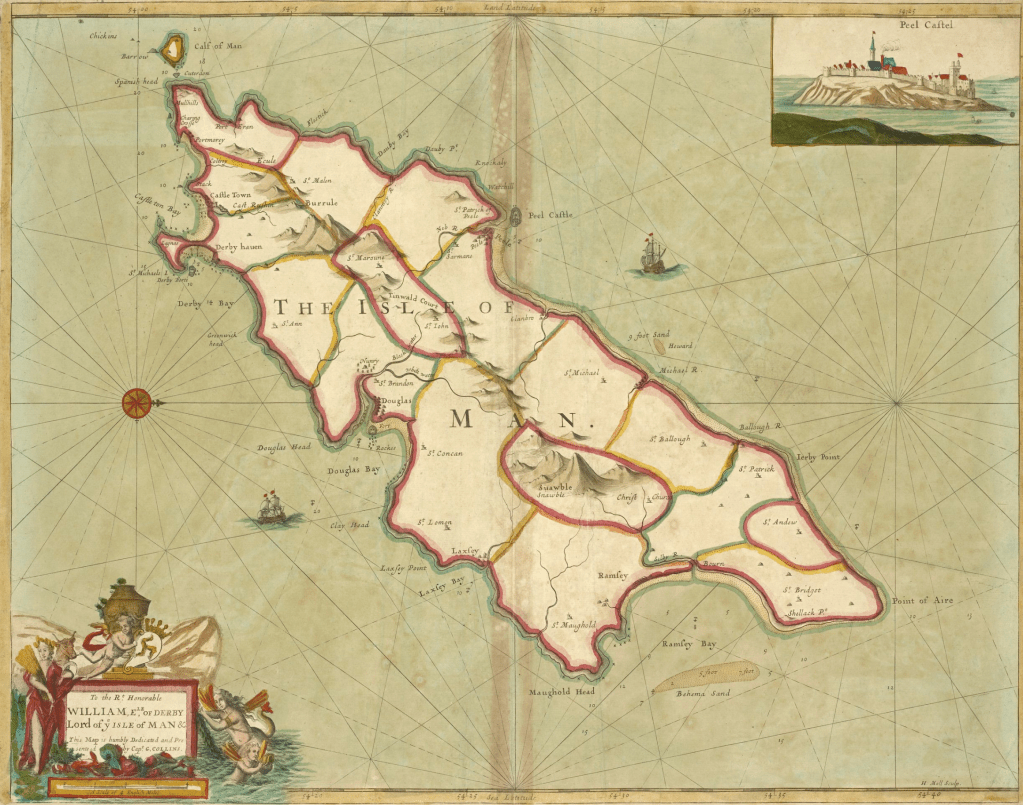
Artwork Source: “To the Honorable William, E.le. of Derby, Lord of ISLE of MAN,” Samuel Thornton. From the Public Domain.
Footnotes
- “History,” Tynwald, accessed December 1, 2024, https://www.tynwald.org.im/history#the-oldest-continuous-parliament-in-the-world.
↩︎ - “Women’s Suffrage,” Tynwald, accessed December 1, 2024, https://www.tynwald.org.im/history/Women-Suffrage.
↩︎ - Bill Whitaker, “Isle of Man Home to the World’s Most Dangerous Motorcycle Race | 60 Minutes,” CBS News, May 26, 2024, https://www.cbsnews.com/news/tt-isle-of-man-motorcycle-race-60-minutes-transcript/.
↩︎ - “Crown Dependencies,” The Royal Family, accessed December 1, 2024, https://www.royal.uk/crown-dependencies.
↩︎ - “Tynwald – Members & Officers,” Tynwald, accessed December 1, 2024, https://tynwald.org.im/members-officers.
↩︎ - “Our Programme,”Net Zero, accessed December 1, 2024, https://www.netzero.im/our-programme/our-programme/.
↩︎ - Ibid ↩︎
- “Discover the Story of Manx | Learn Manx,” accessed December 2, 2024, https://www.learnmanx.com/resources/community/speak-up-for-manx/discover-the-story-of-manx/.
↩︎ - “Manx Language: How Did It Return from the Dead?” Global Language Services, accessed December 2, 2024, https://www.globallanguageservices.co.uk/manx-language-return/.
↩︎ - Ibid ↩︎
- “Manx: Bringing a Language Back from the Dead,” BBC News, January 29, 2013, sec. Magazine, https://www.bbc.com/news/magazine-21242667.
↩︎ - “Manx Language: How Did It Return from the Dead?” Global Language Services.
↩︎ - “The Great Laxey Wheel – Queeyl Vooar Laksey,” Manx National Heritage, accessed December 3, 2024, https://manxnationalheritage.im/our-sites/laxey-wheel/.
↩︎ - “Isle of Man Steam Railway” Visit Isle of Man, accessed December 3, 2024, https://www.visitisleofman.com/experience/isle-of-man-steam-railway-p1291361.
↩︎ - “UNESCO Biosphere Isle of Man Biosphere,” UNESCO, accessed December 4, 2024, https://www.biosphere.im/.
↩︎ - Ibid.
↩︎ - “Manx: Bringing a Language Back from the Dead,” BBC News.
↩︎ - Interview with James Franklin of Culture Vannin
↩︎ - “Singer Ruth Keggin ‘breathes Life’ into Ancient Language,” BBC News, February 15, 2014, sec. Isle Of Man / Ellan Vannin, https://www.bbc.com/news/world-europe-isle-of-man-26120451.
↩︎ - Ibid. ↩︎
- “GB News Platforms the Far Right, Conspiracy Theorists and Racists,” HOPE Not Hate (blog), July 14, 2023, https://hopenothate.org.uk/2023/07/14/gb-news-platforms-the-far-right-conspiracy-theorists-and-racists/.
↩︎ - Paul Burgess: Climate Realism | Tom Nelson Pod #136, 2023, https://www.youtube.com/watch?v=CvQWkFgHZD4.
↩︎
 turningleafjournal.com