
There Is A Space That Exists Between Helplessness and Anger
By Kevin Krein
And it’s a Sunday night, four days after Renee Good has been shot and killed by ICE agents, in Minneapolis, 42 miles north of where I live, when my mother texts my spouse and asks her, “What’s wrong with him?” And what is wrong with me? Four days after Renee Good is shot three times and killed by an ICE agent while she sits behind the wheel of her car, in a telephone conversation I have with my mother, she tells me she is worried I am going to get “mixed up in all that.” And I inquire as to what she means by this—“Mixed up in what?” I ask her. “You worry about me? Why do you worry about me?” I continue, unrelenting because it is 9 a.m. on a Sunday morning and I am already so tired and so angry. “Are you worried I am going to get shot in the face by an ICE agent?” my voice rising quickly, and fills with something that my mother is frightened and surprised by and in this fear and in this surprise she gasps and chokes on her words and the only thing she can muster within this absolutely inhuman sound is the word “no.”
And this is of course intentional on my part because I know very well that my mother, in my obligation to call her every Sunday morning, that she, before lamenting about her own life and her own unhappiness, will halfheartedly ask me how I am doing and how my week was and I usually tell her that things are fine or that it has been a quiet week but four days after Renee Good has been shot and killed I tell my mother that it has not been a good week and I have not been doing that well and when she feigns concern and asks me why my first thought is how could you not know where this is going to go but the only thing I can manage to say in that moment with exasperation in my voice is, “A woman was murdered.”
And this is of course intentional on my part because I want her to sit in the discomfort and understand how disappointed and frustrated I am with her and really always have been because she in 2016 exclaimed how she thought Donald Trump was a pig but in the same breath said she was voting for him anyway and how what is happening right now is in a broad sweeping sense her fault and she has this blood all over her hands and I wonder if she even understands her complacency.
And I have intentionally brought my mother into this place where we are both but for very different reasons uncomfortable and perhaps unprepared for what will follow but more and more what I find is I am no longer concerned about if something I do is going to be upsetting to her because you can end a telephone conversation by saying, “love you, too,” but that doesn’t mean you have to like the person on the other end and this is how it feels to me most Sundays. And on the phone, I tell my mother that a woman was murdered and her response to me is yes, she heard about that and she tells me that what is happening right now in the Twin Cities—42 miles from where I live—what is being referred to a “Operation Metro Surge,” and the murder of a woman—these are things that I shouldn’t let bother me, or upset me, as much as they are.
And my voice, again, rises, quickly returning to the cadence that fills her with fear and I am yelling, now, into my phone, waving my arm around, pointing my finger toward the living room window as if to indicate something she should be able to see from where she sits, in her home, hundreds of miles and two states away. And I shout into the phone, “How am I not supposed to let this bother me when there are ICE abductions happening down the street from me?” I ask her, “How am I not supposed to let this bother me when there are ICE agents sitting in idling cars, parked in front of my fucking house?”
“But who are they looking for?” she responds, incredulously. And when I say, “Why does that matter?” she asks again. “Who are they looking for? Everyone in your neighborhood has lived there for a long time.” And when she tells me this I begin to seethe and it is then that I explain we are actually all done with the conversation, only a few minutes in, because through gritted teeth what I manage to say is, “You are backing yourself into a conversation about race that I do not think you wish to have with me right now.” And she is flabbergasted and says that we will talk next Sunday and I scoff at the very notion of speaking to her again and end the call, throwing my phone down onto the floor and it makes a flat, thudding sound as it bounces, once, and then lands again.
::
His name is Adan Nunez Gonzalez and he’s abducted by ICE agents on the morning of Tuesday, November 11th. The Twin Cities-based news outlet, The Sahan Journal, is the first to pick up the story, or offer any real insight into his abduction—their coverage is published two days later. And of course, a small town, 40-something miles south of Minneapolis and St. Paul, has small-town resources. I am not certain what kind of commentary was offered on the air in the days that followed Gonzalez’s abduction, but the town’s radio station publishes a single, short blurb about it on their website, 13 days later, focusing primarily on the denial of his asylum. They refer to it as a developing story, explaining that little information about the incident has been released to the public.
And of course, a small town has small-town resources—the local newspaper publishes a piece about Gonzalez ten days after the abduction occurs. And in my outrage, and in my disappointment with how it seems like this is not something that we, as a town, are going to talk about, or wish to address, there is a part of me that wishes to have grace and understanding. The violent abduction, in broad daylight, of a community member, is something that is difficult to provide insight on, objective or otherwise. I wish to have grace and understanding because small towns have small-town resources, and both the radio station and the local newspaper are spread thin and understaffed.
I wish to have grace and understanding but here there is a challenge because there was a time, a decade prior to this, when I did write for this very newspaper and the threat of being scooped by a larger outlet from the Twin Cities on a local story hung like a specter over the newsroom’s cubicles and the very thought of not offering anything at all on a story of this importance and magnitude for over a week was simply unfathomable.
Gonzalez is abducted in November and what is referred to as “Operation Metro Surge” officially begins in December—focusing, at first, on the Twin Cities area, becoming more tenacious, and expanding to other parts of the state, including the small town I have lived in for 20 years. A population of 20,000 and change, some 40 miles south. And when the coverage inevitably unfolds—the ICE abductions, and the protests and the marches and the demonstrations and the ICE agents slipping and falling and people cheering and the crowds dispersing because someone has fired teargas into them, it is happening in Minneapolis and St. Paul. But of course it is happening, to a lesser extent, elsewhere. You don’t think that it can’t happen in a town of 20,000. You just don’t think it’s going to. It does.
His name is Adan Nunez Gonzalez. A house painter and a father of four who was on his way to a job site on the morning of Tuesday, November 11th when his vehicle was surrounded by ICE agents who, when asked to provide a warrant, refused to do so. Gonzalez remained in the vehicle. The windows were broken. He was violently extracted and arrested. It occurs .2 miles from my own. Google Maps alleges it’s a four-minute walk from my door to the intersection where it takes place.
Seven days later, in St. Paul, there is a large-scale ICE raid on a distribution warehouse .7 miles, or a two-minute drive, from where Alyssa, my best friend, lives. And there is a space that exists between helplessness and anger, and in that space, Alyssa feels empowered to do something. Anything. Because it is hard to know what to do, or where to begin. It is easy to feel overwhelmed or paralyzed in moments such as this. She finds an organization hosting a Constitutional Observation training course on a Monday evening in early December, at a library near her home. She registers, and in doing so, encourages me to attend with her.
And characters emerge, of course, while she and I are in the training—the woman, aimlessly knitting, her yarn in a crinkly plastic bag, who, after interjecting enough throughout the night, must reveal she used to work in law enforcement. The man, near the back, perched on the edge of his chair in a way that feels sinister, who seems more interested in learning about participating in civil disobedience rather than orderly observing.
The elderly woman, who, whenever she is unable to understand what someone in the room is saying, will yell out over the top of them, “Can’t hear!”
Even with these characters emerging, the facilitator tries his best to keep things on track. The information we receive, at the time, feels helpful, though it is ultimately more of what not to do, or what to avoid in terms of potential interactions with ICE. We’re told where to send video footage recorded on our phones of a suspected incident or abduction. We’re provided with what the facilitator calls Red Cards—a business card-sized legal resource intended to help someone understand their constitutional rights. But, really, when it comes down to it, what is a flimsy card going to do?
The sky is black and it is gently snowing when the training concludes and Alyssa and I walk back to my car and on the drive back to her house we both agree that we are glad to have attended and to have been provided this information. Because in that moment it is something that might fill the space that exists. The space between helplessness and anger. The paralyzation that comes from the urge to do something and the uncertainty of where to begin.
We both, quietly, hope that neither of us will be in a position where we need to use the information.
And it’s a Tuesday afternoon. December 8th. The next day. Less than 24 hours after attending the Constitutional Observation training, I received two texts from people asking me if I know anything about a reported ICE presence on my street—“Activity confirmed. Multiple Vehicles—dark SUVs. Black, gray, maroon.”
It’s snowing. Enough that it is beginning to pile up in the street. And I cram myself into my winter boots and fumble with my bulky winter coat and I trudge outside and I do not know what I am looking for but there is this emergent feeling inside of me as I stand in the middle of the road, looking to either side. It is quiet at first, and I let a moment pass in the quiet, and I just begin walking because I do not know what I am looking for or what I expect to see or where I might see it. I do not know which house I will see violence spilling out of. I nervously pat the pocket of my coat over and over as I walk, ensuring the materials I had been given the night prior, at the training, are still in there. But, really, when it comes down to it, what is a flimsy card going to do?
A number of cars begin, in quick succession, turning down my street, driving slowly. The drivers and passengers, seemingly on alert, giving me a knowing glance. A nod. I understand these people have also received notification about this confirmed activity, and are here in response to it. They are, as I am, perhaps uncertain what they are looking for or what they expect to see or where they might see it.
A Subaru station wagon turns down the street, and slows, and the woman behind the wheel addresses me, as I stand in the road near a stop sign. She’s intense—dark black and gray hair, dark brown eyes and a furrowed brow. A retired attorney. She asks me if I’m the one who called it in. I tell her no, that I had received texts about it. I just live here. The blue and yellow house. She drives ahead, parking in front of my house, and gets out to talk. We both look around, uncertain what we are looking for or what we expect to see or if we are missing something. If we’ve missed something that has already happened. Or is happening right now. A neighbor, from two houses down, wanders out into the street. Walking slowly. He cautiously approaches us and explains that his spouse received the alert on her phone, and called him, telling him to go outside and investigate what was happening. What was happening. It’s so quiet. The retired attorney asks me if there are any Latino families living on the street. I tell her yes, there are. My next-door neighbors. An enormous family.
I am, suddenly, afraid for them. I wonder if they have already been living in fear before this moment. And if they have, for how long.
Wednesday. December 9th. The next day. The next morning. Not even 8 a.m. when I look out my living room window with my coffee mug still in hand and notice a gray Dodge Charger, engine running, windows tinted, parked in front of my house, and I do not think discretion is something the ICE agent, behind the wheel of this car parked in front of my home is concerned with but I try to be discreet as I walk down to the mailbox, and then back, to further look at the car. I do not think discretion is something he is concerned, with but I try to be discreet as I fumble with a snow brush, clearing away the snow from my spouse’s windshield, as I cautiously zoom in on the Charger’s out-of-state license plate, taking a photo of it, sending it to the telephone number for the local alerts. I am told that somebody will arrive shortly to confirm if it is, in fact, an ICE vehicle.
Someone from my neighbor’s house is outside, too, starting one of the cars in the driveway, and brushing it off. I call to him—the son-in-law, a teacher, I think. One of five or six people living in the home. I ask him if he wants help cleaning his car off. He politely declines and I am afraid for them. This family. The son-in-law continues to brush away the snow and I continue to keep my eyes on the Charger, the exhaust billowing from the tailpipe. I walk over to my neighbor’s house, two Red Cards in my hand. “I’m sorry to bother you,” I say. “That car parked in front of my house? The Dodge Charger? I think it’s an ICE vehicle. I called it in and someone is coming to confirm, but I wanted you to give these cards to you, so everyone in the house understands their rights.”
I tell him to be safe. I apologize again. But, really, when it comes down to it, what is a flimsy card going to do?
A minivan pulls up and is barely thrown into park before a woman—tall, thin, brown hair put up in a bun, jumps out, her cell phone camera already recording. She wears a vibrant, red flannel shirt that is partially covered by a sand colored tactical vest. Her face is covered. She approaches the Charger without hesitation, narrating as she films, then playfully taunts the driver through his closed windows.
The plates—from Washington state, come back as a confirmed ICE vehicle.
The intense retired attorney arrives shortly after the minivan, as does another person. A man. The three of them talk amongst themselves while I stand at the end of my driveway, uncertain what, if anything, I am supposed to be doing. The question of who, on this street, the “target” might be, keeps coming up, and I continue glancing back at my neighbor’s house, wondering. Wondering if there is something more I should be doing. Wonder if there is something more that I will have to do, in the days that follow.
After five or ten minutes of everyone gathered at the edge of my driveway, the ICE vehicle unceremoniously comes to life and slowly begins pulling away from where it was parked and idling, making an awkward three-point turnaround before it drives by. The man who arrived last quickly gets back into his own car, and begins pursuing the Charger. Both cars heading down to the end of the street, to the stop sign, turning left, and then out of sight.
::
Operation Metro Surge begins in early December and it makes days, and weeks, and months, feel like a lifetime. The news of the day is nearly always bad news. Renee Good, a woman, unarmed, behind the wheel of her vehicle, is shot and killed after a tense exchange with an ICE agent. Reports will indicate she was acting as a legal observer. A Constitutional Observer. As was Alex Pretti. He was murdered on January 24th. And yes he was armed and had a permit to carry and yes so much has been made of this and I make the mistake of watching slowed-down video footage of his death and his hands are nowhere near his weapon. He’s holding his phone, in his hand, filming ICE activity on Nicollet Avenue in Minneapolis.
He is shot multiple times in quick succession.
And yes there are the protests and the marches and the demonstrations and there is the resistance. The opposition. On the telephone with my mother, four days after a woman is murdered and there is outrage in the streets, she asks in a voice that exists between resentment and trepidation, if I had gone to any of the protests or marches and when I tell her no, I haven’t, she sighs heavily in relief but her relief is short lived after she confesses her concern for me. “I worry you are going to get mixed up in all that,” she chides me, and it is then that I ask her to explain what she means by that and she is, in that moment, unable or just unwilling to do so.
It’s called Operation Metro Surge, and in my small town, of 20,000 and change, some 40 miles south of the Twin Cities, the local alerts as to suspected ICE activity usually come early in the morning. Anecdotally on specific days of the week. Tuesdays, it seems. Sometimes on Wednesdays. Sometimes even the weekend. Saturdays. Living in a constant state of fear and vigilance does not get the weekend off. And the alerts come. My watch, again vibrating to notify me of the messages. Sometimes it’s simply information about a suspected ICE vehicle that has been spotted somewhere. Make and model and license plate and the last location the vehicle was seen or perhaps might be heading. Most of the messages conclude with “No additional support is needed.”
And there are of course the notifications that are so much more upsetting. The space that exists between helplessness and anger because what are you supposed to do or how are you supposed to feel when you see a message come across your phone screen that says, “Confirmed: 4 SUVs with ICE agents at the Jefferson Drive Apartment Complex. NY Plates. Dark gray Nissan. Agents wearing ERO vests and masks,” followed by, “Agents entering Jefferson apartments. Don’t open your doors.”
Or a message that ends with, “Shelter in place.”
::
I remember the first time I disappoint my mother, politically.
It’s in 2005—the summer after I finished college. Sitting in the passenger seat of her car, I make a disparaging remark about George W. Bush, and there is this deep well of sadness in her voice when she timidly responds, telling me that she had always believed that when I voted for the first time, as I had done in November 2004, at the age of 21, that she and I would be politically aligned.
And on a Sunday evening in January years and years after that moment and four days after Renee Good has been murdered and maybe 10 or 11 hours after the conversation with my mother ended with me throwing my phone on the ground, that she texts my spouse, and asks her, “What’s wrong with him?”
And there is both nothing wrong and everything wrong and there is this space that exists and continues to exist between helplessness and anger. And there is nothing wrong, at all, with finding yourself in the center of those two things as they slowly continue to converge.
A few weeks later. Another Sunday. On the phone, my mother will ask me if things are “calming down up there.” And it is only later when I relay this story to others that I understand this was her veiled attempt to ask about the ICE presence in the state and in my small town because yes, eventually, after enough press conferences and pleading from politicians and after the marches and the demonstrations and the protests and after the lives lost and the fear and the families torn apart, there is tell that Operation Metro Surge is slowing or coming to an end though with the amount of updates I am still receiving about the activity with my small town, I am skeptical.
“Are things calming down up there?” my mother asks me and in the moment, because I do not understand, I tell her that I don’t know what she means by that and she can only laugh, nervously, and I can hear fear rippling to the top of her voice and then she asks, “Is your schedule still busy?”
The alerts about suspected activity do eventually stop arriving but there are still “ICE Out” signs in windows of homes and of small businesses and there is still a flurry of “Fuck ICE” graffiti on the side of buildings and on the walls that line the freeway between St. Paul and Minneapolis that have not been scrubbed away and maybe never will be.
There are still immigrant-owned businesses that are trying to recover.
There are the businesses that were not able to recover at all.
Kevin Krein (he/him) has been writing about music on the internet since 2013—first on the blog Anhedonic Headphones, and now on his website. Kevin has contributed to Atwood Magazine, and his work has been published in River Valley Woman, The Wagazine, and SouthernMinn Scene. Kevin co-hosts No Returns, a podcast about things found in Little Free Libraries, with writer Alyssa Savino. Kevin lives in Northfield, Minnesota, with his spouse, filmmaker Wendy Placko, their dog, Po, and cat, Daphne.
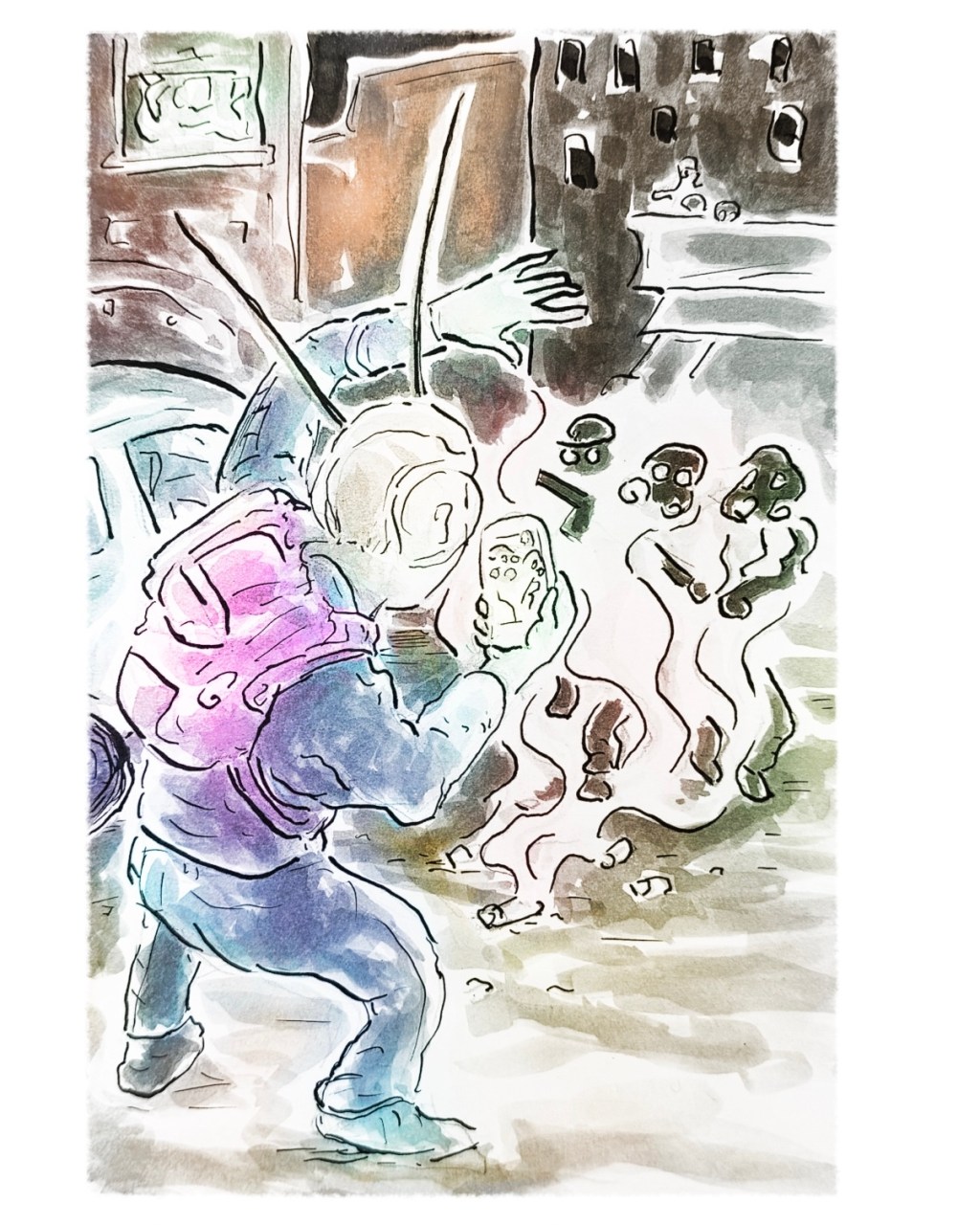
Artwork Source: “Heroes in Our Streets,” Matt Laux
Artist Statement: Record what is happening to us
Preserving evidence
Of atrocities
10 in x 4 in
2026
Matt Laux is a father, chef, and artist living in Iowa City. Working with watercolor and ink, and also chalk art, Matt finds joy exploring natural and reflective worlds. When not painting, Matt enjoys cooking over the fire in a makeshift outdoor kitchen with friends and family
 turningleafjournal.com