The Day We Let It Stop
By Kumar Sen
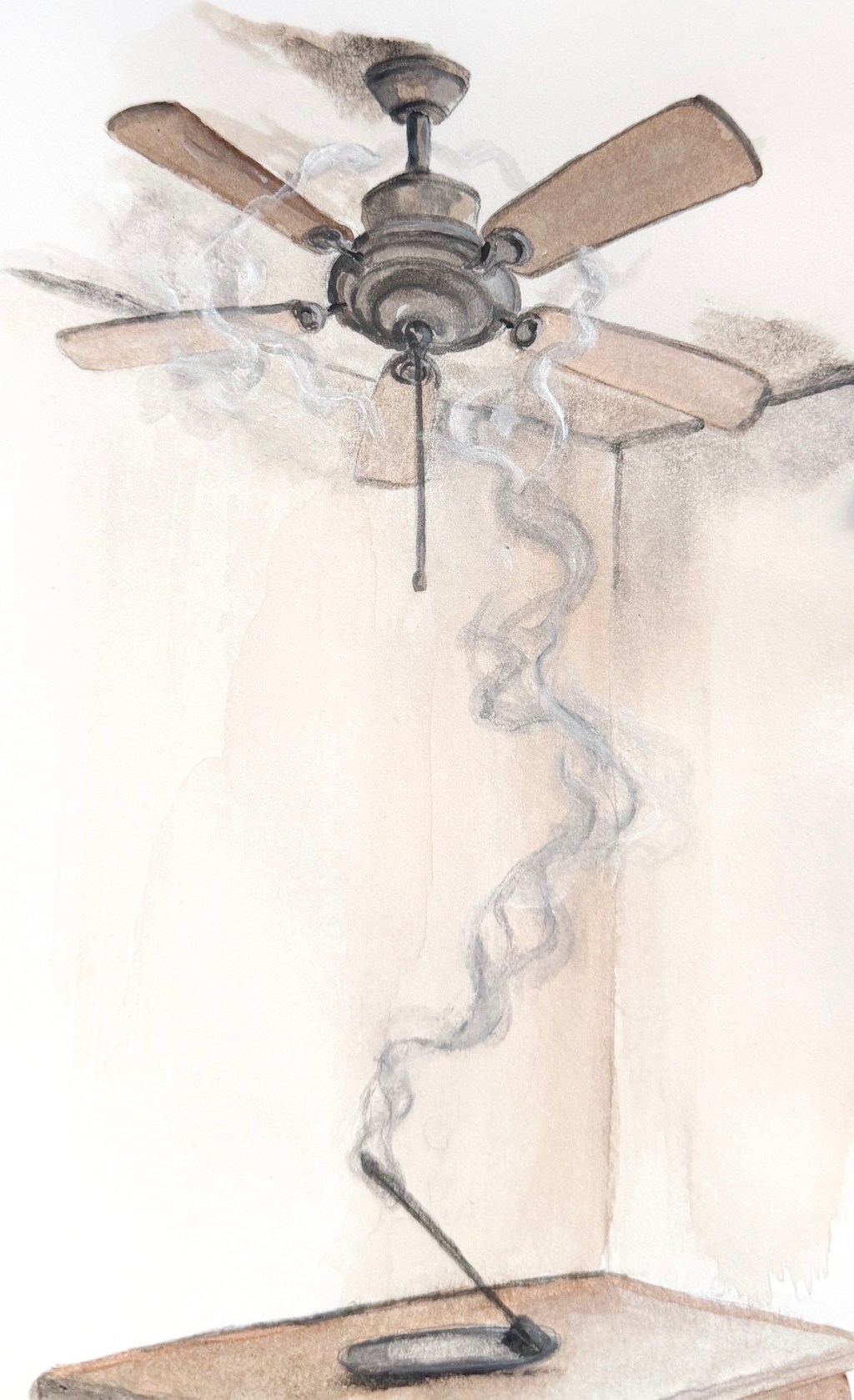
The day the ceiling fan stopped, my mother was in the middle of a prayer. The kind that moves silently through the lips, as if the words have been used so often they no longer require sound. Her fingers hovered close together, suspended between habit and rest. The incense had burned halfway down, releasing a thin curl of smoke that bent and straightened in the heat.
Above her, the fan slowed. There was no jolt, no protest—just a gradual surrender. Each rotation stretched thinner than the last until the blades settled into stillness, as if the air itself had withdrawn its permission.
My mother opened her eyes, looked up once, then lowered her hands. The prayer remained unfinished.
In our house, things were carried through. Meals ended with empty plates. Conversations, however strained, found their way to a closing sentence. Once a prayer began, it was seen to its end—even if the voice faltered, even if the words arrived unevenly.
“Half-done things stay with you,” my mother used to say. “They don’t leave. They wait.”
When I was younger, I believed her. I imagined unfinished prayers gathering above us, pressing against the ceiling like heat sealed into a closed room. Maybe that’s why I stayed quiet for so long.
Leaving didn’t happen all at once. It began in ways small enough to excuse.
The first shift was almost invisible—I kept my eyes open during prayer. I stood beside her, hands loosely joined, watching the flame instead of yielding to it. The wick leaned slightly to one side; the oil trembled at its base. It looked more fragile than I expected.
Afterward, she asked, “You weren’t concentrating?”
“I was.”
Her gaze lingered, measuring something she didn’t name. “Next time,” she said, “try harder.”
After that, the changes came more easily. I stopped bowing my head. I stopped touching the floor before the shrine. Eventually, I stopped coming at all.
Each step felt small enough to defend, yet large enough to be seen.
My mother never asked me why. Instead, she adjusted—quietly, precisely—the way furniture shifts to accommodate something unfamiliar. When I stayed away, she lit an extra stick of incense. On fasting days, she kept something warm aside for me, placing it in the kitchen without comment.
During one festival, she pressed vermilion onto my forehead while I was distracted. I wiped it away before I realized what I was doing. Her hand remained in the air a second too long. It was recognition.
The fan had always been there. My father liked to say he had installed it himself. The details shifted each time he told the story, but the conclusion never changed.
“It’s a good one,” he would say. “They don’t make them like this anymore.”
Even when it began to wobble, he said it. Even when the hum deepened, filling the afternoons with a steady mechanical presence, he said it.
“It still works.”
For him, that settled the matter.
The day it stopped, he wasn’t home. My mother and I sat beneath a silence that felt newly placed.
“Electricity?” I asked.
“No.”
She rose and pressed the switch off and on, once, then again, as if repetition might restore something. The blades didn’t move. She left the switch on. Nothing followed.
“Should we call someone?” I asked.
She returned to the shrine and tapped the ash from the incense into a small steel bowl, the gesture careful, controlled, as if precision could compensate for interruption.
“It will start,” she said.
“How do you know?”
Her eyes met mine. “Things don’t just stop.”
I wanted to tell her she was wrong—that things end all the time, quietly, without warning. Belief thins out. Certainty loosens its hold. Even the version of yourself that once fit neatly into your family’s expectations can slip away so gradually that the distance only becomes visible afterward.
What I said instead was, “Maybe this one did.”
Something tightened in her expression. “Don’t speak like that,” she said.
“Like what?”
“As if it’s easy.”
I wanted it to be easy. I had been practicing the distance for years.
“It isn’t,” I said.
That night, the heat settled into the walls. Without the fan, the air felt heavy, almost textured. Sleep came in fragments; the sheets clung, and every movement seemed louder than it should be.
From the other room, I could hear my mother shifting. Then a match struck. The smell that followed wasn’t incense—it was camphor, sharper, faster-burning, leaving almost nothing behind.
The next morning, the shrine remained untouched. No flame. No smoke. No familiar rhythm of words carried from memory.
“You’re skipping it?” I asked.
She wiped her hands along the edge of her sari. “I want to see,” she said, “what happens if I don’t.”
“To what?”
She held my gaze, then looked away. “I don’t know.”
When my father returned, he noticed the fan immediately. “What happened?”
“It stopped,” my mother said.
He frowned, as if the statement itself needed correction. “Things don’t just stop.”
He pulled a chair beneath it and climbed up, already certain of the solution. “Loose connection. Nothing serious.” He tightened screws, adjusted wires, switched the power off and on. “See?”
The fan jerked once. Then again—just convincing enough to make us wait. Then it stilled.
He remained there a moment longer than necessary. “It was working,” he said.
“It’s old,” I said.
He looked down at me. “So?”
“So maybe it’s finished.”
The word settled between us. Finished.
He climbed down without replying.
The electrician came the next day. He opened the casing, glanced inside, and closed it again with quiet efficiency.
“It can’t be fixed,” he said.
My father’s voice sharpened. “Why not?”
“It’s worn out.”
“That’s all?”
The man shrugged. “Sometimes that’s enough.”
We bought a new fan. It spun smoothly, without sound, without resistance.
“It’s better,” my father said.
Still, he kept looking at the old one leaning against the wall, its blades removed, its center exposed.
My mother stood beneath the new fan and watched it for a while. “It doesn’t sound like anything,” she said.
That evening, she returned to the shrine. She lit the incense and stood there, watching the smoke rise.
Then she said, very softly, “I left it unfinished.”
I couldn’t tell who she was speaking to.
After a pause, she added, “I don’t know if that matters anymore.”
She didn’t wait for an answer. Instead, she did something I had never seen her do: she walked away from the shrine while the incense was still thick in the air, leaving the flame untended. She came into the kitchen, picked up a dish towel, and began wiping down the counter with a strange, heavy slowness. Her movements had lost their precision. When she accidentally knocked over the small steel bowl, scattering a grey cloud of yesterday’s ash across the floor, she didn’t rush to clean it. She just looked down at the mess, her hands hanging loosely at her sides, letting the dust settle on her bare feet.
I stood in the doorway, suspended between entering and leaving. The breeze from the new fan reached us even here—cool, uniform, and entirely clinical. It cut through the heat, but it felt weightless, like a breath that didn’t belong to the house.
That night, lying beneath that seamless, silent spin, my skin was cool but my chest felt tight. My ears strained against the quiet, counting the seconds, waiting for a mechanical hitch or a familiar wobble that I knew was never coming.
I realized then something I had been avoiding. I hadn’t simply left something behind—I had carried parts of it with me. The repetition. The instinct to search for meaning. The unease that follows anything left unfinished.
The fan above me moved steadily, almost invisibly.
Still, I listened for the old sound.
Change rarely arrives as a clean break. It leaves traces—in hesitation, in the shape of sentences that almost resolve, in rituals no longer performed yet preserved in memory, step by step, without effort.
The fan had stopped. We replaced it.
But its rhythm didn’t disappear. It shifted.
Not in the room. In the way we kept listening for it.
Kumar Sen (he/him) is a writer from Kolkata, India. His work has appeared in Reading into Culture, Unbroken Journal, New World Writing Quarterly, Flare Magazine, Behemoth Magazine, and SFWP Journal, among others. Trained as a mathematician, he writes in Bengali and English, exploring sensory detail and the subtly absurd. He is also a musician, composer, and bibliophile.
Artwork Commissioned From Anita Eralie Schley
Anita Eralie Schley graduated from the University of Utah in 1996 with BFA in Studio Art. In addition to having her work in a multitude of galleries and publications, she has also taught art through continuing education classes, an Alternative high school drawing class in Box Elder County, the college setting as an alternative photography processes substitute at Salt Lake Community College and was the photography program director for CLASS Art School. Anita is both a painter and a photographer and enjoys exploring different mediums in her artwork. She has received multiple awards throughout her career including most recently: Honorable Mention 2023 for the Workshop13 exhibit RED, Award of Merit 2022 Utah Women Artists Exhibit, Best of Show 2020 Box Elder Museum Photography group exhibit. She lives in Springville, Utah with her husband. She has four adult children and recently became a grandmother for the first time.
 turningleafjournal.com