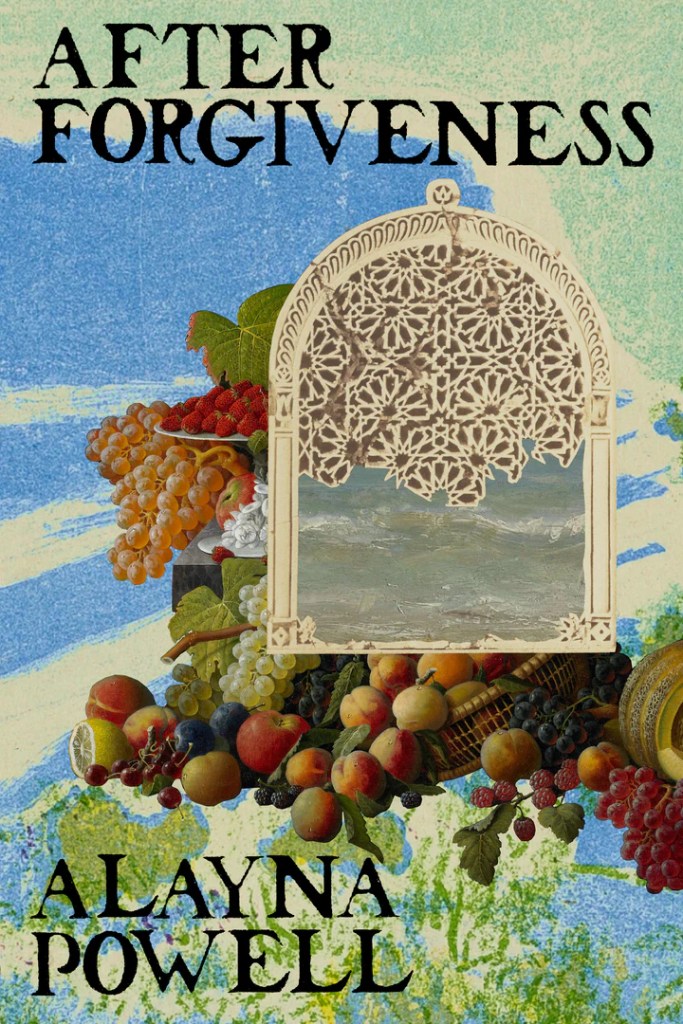
A Review of Alayna Powell’s After Forgiveness
By Jonathan Fletcher
In only twenty-seven pages, Alayna Powell readily and courageously examines love and loss, illness and recovery, trauma and joy, and other timely subjects that lend themselves to serious reflection and introspection. With titles that vary in length, frankness, and opacity (titles such as “Roots,” “The Hull of the Muscadine Grape,” and “I want to spend the rest of my days fishing with my father”), After Forgiveness, Powell’s latest chapbook of poetry (published by Bottlecap Press), both questions and affirms, explores and reclaims. In “Milk & Butter Bread,” a meditation on illness and loss, the speaker acknowledges the complexity of feelings around their mother’s disease: “I’ll be sure I’ve found / the meaning in my mother / getting cancer. I was God / twiddling her fingers. . .” (Powell 8). Beyond the notable use of a female pronoun for the divine (a theologically refreshing image that recurs in the collection), the piece masterfully evokes questions of philosophical import through arresting imagery, as well as sophisticated enjambments that allow for especially multivalent monostiches:
“We’ve only ever known
anguish in this vast womb, spun
by her: meticulous fingers,
palm swaying.
When I return home
there is a cool cup of milk
& butter bread
waiting for me”
(emphasis added, 9)
What makes After Forgiveness stand out is not simply the artistry with which Powell recounts and imagines (proving herself a poet to watch) but the diversity of form within. Throughout her collection, the reader is treated to numbered poems, pieces in couplets, prose poems, and everything in between. None of it, though, feels artificial. Though full of original moves and unique structure, After Forgiveness is nothing if not sincere, however playful at times. Not always an easy read, her latest chapbook of poetry is a rewarding one. It is a necessary one. Ignore it at your peril.
Alayna Powell (she/they) is a biracial, Black, hybrid writer who has lived in six states. Her poetry, flash fiction, and book reviews have appeared in Poetry Foundation, The Bangalore Review, Tinderbox Magazine, and elsewhere. She is the recipient of The Good Life Review’s 2025 HoneyBee Prize in flash creative nonfiction. She holds an MFA in Creative Writing and an MLIS certificate in Archival Studies from the University of Alabama, where she served as the 2025 Poetry Editor for Black Warrior Review. Her debut chapbook, After Forgiveness, was published by Bottlecap Press in 2024.
Jonathan Fletcher holds a Master of Fine Arts in Creative Writing from Columbia University School of the Arts. His work has been featured in numerous literary journals and magazines, and he has won or placed in various literary contests. A Pushcart Prize, Best of the Net, and Best Microfiction nominee, he won Northwestern University Press’s Drinking Gourd Chapbook Poetry Prize contest in 2023, for which his debut chapbook, This is My Body, was published in 2025. Currently, he serves as a Zoeglossia Fellow and lives in San Antonio, Texas.
More from Summer 2026
Letter From the Editor: Oops! All Book Reviews
 turningleafjournal.com
You must be logged in to post a comment.