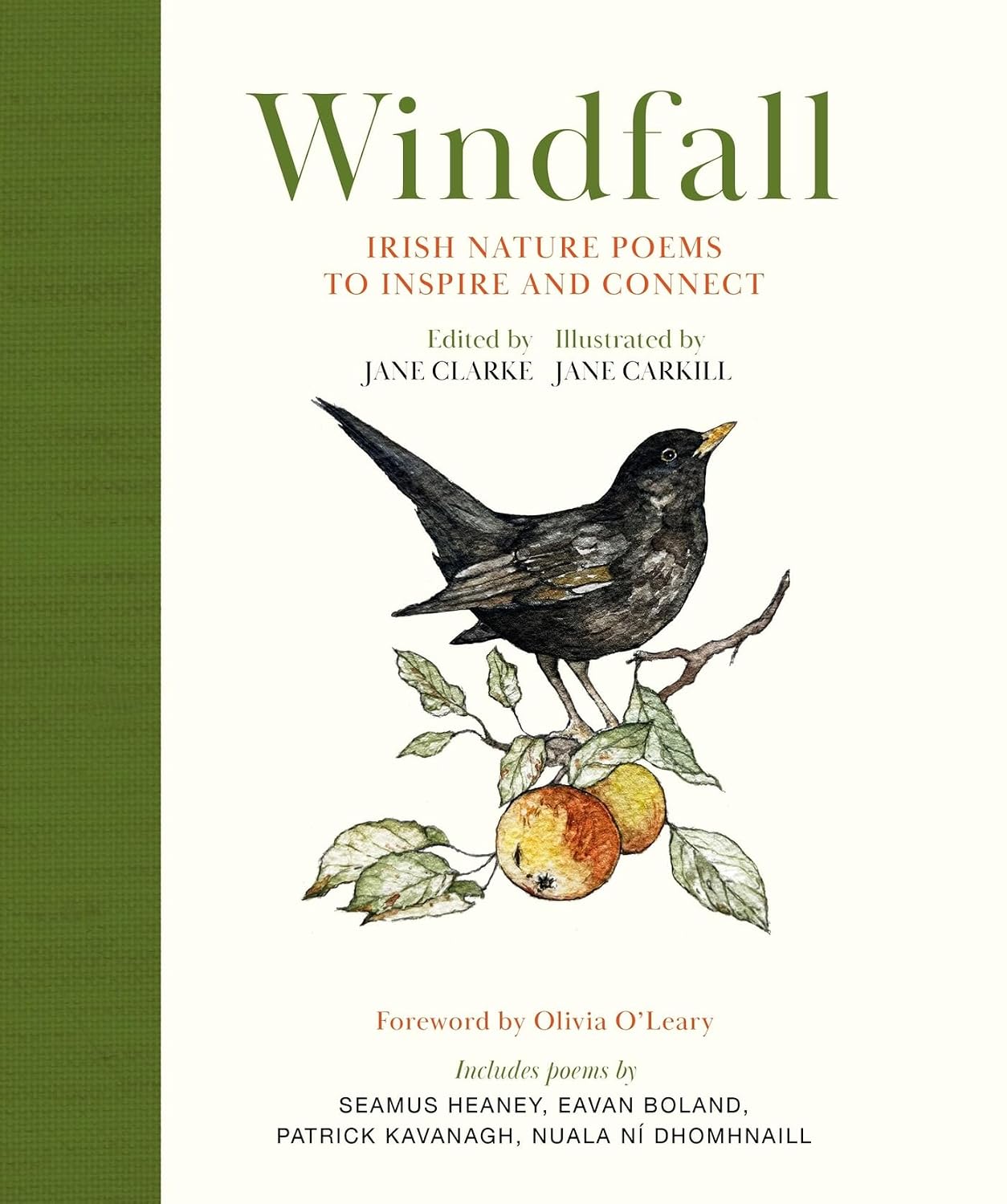
A Review of Windfall: Irish Nature Poems to Inspire and Connect, Edited by Jane Clarke
By Maddison O’Donnell
Nature writes poetry all around us, every day, just by existing – much to the delight and wonder of those of us fortunate enough to observe it. In Windfall: Irish Nature Poems to Inspire and Connect, editor Jane Clarke curates a time-spanning collection of human attempts to capture the poetry inherent in the landscape, flora, and fauna of Ireland. An anthology thoughtfully illustrated by the delicate watercolours of Jane Carkill, Ireland’s landscape is portrayed through ink and paint as an awe-inspiring and beautiful, but fraught land – inherently connected to the spiritual while also existing both physically and metaphorically as a victim of human contestation and devaluation. Through it all, Clarke’s selected poems invite the reader to observe, with great gentleness, the complexities of the land laid bare.
Clarke organises the collection by separating poems into undulating sections representative of traversing the Irish landscape. Readers begin grounded in “Woods and Trees,” then venture through sky, sea, and earth before landing, quite aptly, with “The Land.” Though the sections are thematically organised, there is significant overlap between individual poems and sections, furthermore acknowledging the vastness and interplay of nature pushing at the bounds of human attempts to sort and categorise.
Central to the anthology is a triumvirate of language, spirituality, and wonder. Poets wrestle with myriad mysteries of a nature both known and unknown through multiplicity of language (English, Irish, and “Earthen”) and reckon with the duality of an environment simultaneously nurtured and threatened. In doing so, the poems themselves, through Clarke’s thoughtful curation, deliver a clear message: the attempts of the poet need always be to observe and hypothesise – never to define and conquer – a nature that speaks its own language.
This poetic humility lends itself beautifully to capturing some of the most elusive parts of Irish nature. The majority of poets presented in Windfall acknowledge nature’s place as something inherently spiritual and divine – sometimes acting as a folkloric “thin space” between the living and the dead. Animals are messengers for departed souls. Rain and grass touch everything on either side of the veil. Tree roots and vines reach deep from their earthy bed to some unknown beyond. For poets like Nick Laird, author of “Night Sky in Tyrone,” Ireland’s garden birds “provide the eyes the dead look out of,” whereas in “Calling To Me Through the Woods,” Shirley McClure scours a forest in search of a departed loved one, only to surrender their soul to the earth:
But you are in hiding
fastened with the moss, maybe,
to the river wall,
upstanding with the heron
or endurance swimming
with the wisest salmon
back bravely to the dark Atlantic salt.
If nature is truly the “thin place,” however, it sits closer to the oft-mentioned Heaven, which is either directly or indirectly referenced in the majority of the poems within Windfall. Verse rife with words like “miracle,” “spirit,” “holy,” “genesis,” and “soul” peppers each themed section, oscillating between the figurative and the literal. For instance, in Catherine Phil MacCarthy’s “The Bat,” nature quite literally occupies the space between the human and the divine: a bat interrupts a Mass to tarry in the mystical space between the gathered congregation and the heavens beyond. Most intriguingly, MacCarthy characterises the bat as a creature ignoring the mores to which we mortals bind ourselves:
Flew high as the rafters,
creature of the night skies,
tiny claws quivered past
solemn readings from Isaiah,
the Gospel of St Mark?
Chose this occasion
to run amok,
…
break all the rules,
eerily, to dance?
MacCarthy’s work asserts there is no containing the wonders of nature; it, like the divine, is never fully known to us. Similarly, in the more metaphorical “Staring Out the Window Three Weeks after His Death,” Paul Durcan traces the dying of a loved one: “I saw that his soul was a hare which was poised / In the long grass of his body, ears pricked.” Comfortingly, the hare springs forth from the departed’s body after death and continues “popping up out of nowhere, sitting still” contributing, like MacCarthy, a sense of wonder and whimsy at nature having invaded the space between the human and the otherworldly.
The subtext sprinkled through these poetic references of nature’s invasion into human spaces and proclivities, of course, is the dire reciprocal: that humans have invaded nature and pose a threat to its omniscient phenomena, even though we consider it our physical and spiritual home. John Hewitt asserts this uncomfortable truth in “The Watchers,” describing the desire of a badger “to sniff the ground / without the threat of that old monster, man.” It is a bittersweet note contended with even through the final poem presented in Windfall. Francis Ledwidge’s “Home” briefly calls the reader back from the brink of despair in a tender reminder that nature finds a way to prosper, even when things seem irreparably doomed: “This is a song a robin sang / This morning on a broken tree, / It was about the little fields / That call across the world to me.”
Nature, it seems, can conquer all. We can try to capture the language of nature – our efforts are not in vain. Jane Clarke’s compilation does so beautifully, but it also invites us to extend beyond the poetry and the page. The poems in conversation with one another prove that writing, however lovely and valiant, cannot ever fully capture nature’s mystery and magic as much as it can induce readers to venture out and listen to the language of the earth itself, with poetry as a guiding companion. After all, as many of the poets in Windfall attest, it is nature itself that is the supreme poet. It knows and holds more than we can possibly comprehend. And, as I write this review accompanied by the clever chattering of a tiny Goldcrest hopping between the branches of a rain-bathed tree outside my window, I’m inclined to agree.
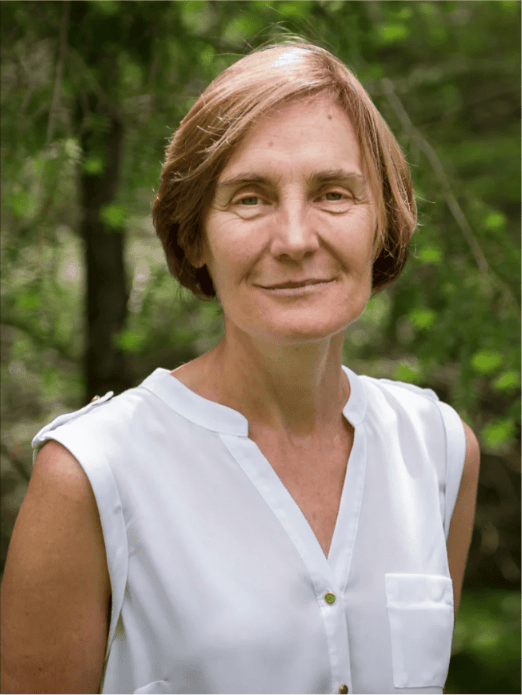
Jane Clarke is the author of three poetry collections, The River (2015), When the Tree Falls (2019), and A Change in the Air (2023), published by Bloodaxe Books. Jane’s fourth collection, Coracle, will be published by Bloodaxe Books in October 2026. Her poetry reflects the interdependence of people, place, and nature while exploring loss and change, both personal and cultural. She grew up on a farm in Co. Roscommon and now lives with her wife in the uplands of Co. Wicklow.

Maddison O’Donnell is a writer of dark fiction and poetry based in Cork, Ireland. She is the grand prize winner of the 2024 International Dark Poets Prize. Her work has appeared in The Wild Umbrella, NECKSNAP Magazine, Salmon Creek Journal, Abyss Literary Magazine, and elsewhere. In addition to her role as Fiction & Poetry Editor for Abhartach Magazine, she reads poetry for The Turning Leaf Journal.
More from Summer 2026
Letter From the Editor: Oops! All Book Reviews


You must be logged in to post a comment.