Hard Swallow
By Courtney Welu
I do not remember learning about death, but I know for certain who taught me.
From the time that I first had language, my Uncle Dunk spoke to me like an adult. He did not hide things from me, did not coddle me, did not talk around any subjects. Death was never off-limits. Death was one of his favorites.
After I die, I’ll be in the spirit world. But don’t worry, I’ll be dropping in on you in your dreams. I’ll be with you even more often after I’m gone.
Despite his best attempts, I have always been afraid of death. When I was a child, I would picture being reincarnated as a dog food bowl in my family’s laundry room, and the empty finality of nothing. Or, I would lay awake all night obsessively pondering the idea of going on forever and ever and ever, with my thoughts and feelings and whims and worries, and it was even more terrifying than nothing at all. I imagined a cement door slamming down on those thoughts.
My sister and I once concluded that it would be easier to lose our Uncle Dunk than other family members, because he would be excited to die. He had faith in where he was going, in the cosmic adventure of his afterlife. He believed wholeheartedly that our births and our deaths are specifically chosen just for us, moments of transformation that bring meaning to the universe.
We all expected him to make it well into his nineties. We weren’t prepared for losing him twenty years early, barely two months after a terminal cancer diagnosis, fast enough to catch everyone off guard, but slow enough that we could say our goodbyes.
There are many wonderful things about dying, Uncle Dunk told us with his characteristic cheerfulness that not even death could stop. Everything is unfolding perfectly.
–
I sat in an airport just before Thanksgiving 2022, sobbing into my phone to my Aunt Janna, because I did not want to get on the plane and see my Uncle Dunk. He was not dying yet; he was not sick yet. But I was sick, and had been sick for most of the year.
At some point after my COVID infection, I developed a sore throat that never went away. It was always thrumming along in the background. At its worst, the pain scorched all the way down from the roof of my mouth to the depths of my esophagus. Sometimes the pain spasmed, sharp and angry. Most of the time, the pain sat at the top of my throat and made it hard to swallow.
I don’t want Dunk to tell me that everything is unfolding perfectly, I cried to Janna, Dunk’s sister. My throat had seared for the past several days, after yet another doctor’s appointment where I was told there was absolutely nothing wrong with me, so there was nothing that anyone could do to help me. This isn’t fucking perfect. If it was, this wouldn’t be happening to me.
I knew my Uncle Dunk’s take on health and illness. Even before I had developed this unknowable throat pain, I’d had chronic headaches nearly all of my life, and my mother had been diagnosed with an incurable chronic illness when I was eight. Dunk always had the same thing to say.
Bad body karma.
I never liked the sound of that, especially coming from a man who had never experienced an ache or pain in his life. It sounded like a way to say it was your own fault for whatever ways your body failed you, but not really your fault, because you don’t know what actions resulted in this punishment.
Looking for a spiritual reason behind illness seems like a good way to lose your mind, and I already felt betrayed by my body. I once cried walking home because at that moment, the future that sounded best to me was for my pain to actually be a malignant brain tumor, so that I could die without making anyone mad at me.
I had no interest in finding whatever alleged “good” came out of my illness. I didn’t want Dunk to tell me that it was all part of a grand plan, because I felt like I was ruining my own life by not getting better, getting more despondent and depressed the longer the pain went on with no change, and no diagnosis.
Dunk received a diagnosis when he became sick, in fall 2023. He’d never been to a doctor in his adult life until he was diagnosed with stage four leukemia and lymphoma. His first inkling that something had gone wrong was a deep, constant pain in his throat.
–
Darrell Emmel – Uncle Dunk to his legion of nieces and nephews– had deep, incontrovertible evidence in support of his theory of the universe, and the proof was his own life. Everything is unfolding perfectly because his life took the exact twists and turns it needed to, bringing him to the ultimate conclusion of dying in his mother’s house ten days shy of his 78th birthday.
Darrell was born in 1946 on a farm in rural South Dakota, the second of two boys. He and his older brother Gayle were inseparable, best friends all their lives. Darrell and Gayle lived together in the years before Darrell died, and Gayle was in the room when Darrell took his last breaths.
Their closeness was due, not in small part, to the fact that they watched their father beat their mother.
Clancy treated Eleanor like a queen – until he got drunk.
Clancy’s abuse allowed Gayle and Darrell to come into existence. It allowed Gayle’s children to come into existence, and it allowed me to come into existence as Gayle’s oldest granddaughter.
I was lucky enough to know Eleanor, my great grandmother, very well. She did not talk about her first marriage often; I certainly learned about the abuse from Dunk.
What Eleanor did have to say about Clancy was this: I had a terrible first marriage and a good second one. But my oldest boys are the ones who take care of me now.
Eleanor died at the age of 94, in her house, with her boys. Darrell had lived with her for thirty-five years, her constant companion and primary caretaker. Darrell died in her house four years after she did. If she had still been alive, his death certainly would have killed her.
More proof that everything is unfolding perfectly.
–
Perhaps unsurprisingly for a white Midwestern farming family, there is a sense among the older generation that the younger generation does not know true suffering. Gayle and Darrell grew up poor, eating “Mom’s dinner mush,” made from flour, salt, butter, sugar, and cinnamon, at least three times a week.
There is also a sense, understandably, that no one but Eleanor, Gayle, and Darrell can understand what they suffered at the hands of Clancy. Not younger siblings, not children, and especially not their grandchildren.
You and your sister were the princesses of South Dakota compared to me and Gayle, Uncle Dunk said, not with bitterness but with great emphasis. Your mom caters to your every whim – do you think Eleanor had time for that with six kids? No, we were on our own, and without the kind of money your dad makes.
I am not allowed to complain about anything to my extended family. Never mind that all of the Emmels transitioned toward the middle class, thanks to the G.I. Bill and a discounted college education for Eleanor’s children. My father, a Welu and not an Emmel, and also the only Republican in the family, made enough money to retire before the age of 50, and therefore nothing that I have experienced can truly be suffering, because my father can throw money at problems to make them go away.
My mother has been sick for nearly twenty years, and all of the money in the world can’t make her pain end.
Dunk certainly acknowledged that he had privileges others didn’t. He was a good Democrat who loved Barack Obama and abhorred Donald Trump. He thought our culture was getting darker and darker, more wrapped up in consumerist bullshit – but he also believed that things would need to get very dark for us to finally see the light, and a spiritual revival could finally take place.
It’s easy to say when it’s not your family facing the world’s worst atrocities.
Ending up in the Emmel family is totally cosmic, because our family is destined for great things. You’re lucky to have me as an uncle. My uncles were farmers, our deepest conversations were about the weather. Whereas you and I, we’ve talked about spirit since you were old enough to talk.
It doesn’t help that he’s right, that I do feel cosmically lucky to have ended up in the family I did. I love the Emmels; I love being an Emmel. I loved having Uncle Dunk in my life.
During one of our last conversations, Dunk told me, I treated you special because you were special. Not because I thought you could be special someday, maybe, but because you are.
Darrell Emmel did suffer in his life, but he was able to look back and see the reasons for everything. His mother had to suffer for him to be born. He himself had to go through a painful divorce to reach a point of spiritual awakening. His adoptive father had to die young so that he could move in with his mother, take care of her, and explore the spirit world in his dreams.
What would have happened if one of his nieces or nephews died as children? Would it be so easy for him to understand the world as perfect then?
In the last six months of his life, Dunk suffered. Something finally, at long last, went wrong inside of his body, after a lifetime of perfect health.
At the end of his life, just as throughout the rest of his life, he did not have health insurance.
You may think that everyone over the age of 65 has Medicaid, but you would be wrong. You have to work to get Medicaid; you have to be a part of the capitalist machine, pay your taxes, and be a productive member of society.
Uncle Dunk was very proud of his uselessness to capitalism. He, unlike the rest of us, had the opportunity to opt out.
Here, according to Dunk, is how everything unfolded perfectly:
In 1968, Darrell Emmel graduated from Augustana College in Sioux Falls, South Dakota, and the draft board descended like vultures. However, Darrell had an ace up his sleeve that the draft board could not anticipate: he had been awarded a Fulbright Scholarship to study World War I history in London, England. At first, the draft board did not care, but Senator George McGovern, about to begin a historic run for the presidency, wrote a letter asking the army to draft Darrell in a year when he returned. Let him take the scholarship he earned.
Darrell spent a newlywed year with his wife in London. Upon his return to the United States, the draft board came calling within the week. They sent him to basic training in Georgia, where he tested well and was promised a relatively privileged job as a military policeman. This was not the future that Darrell chose or desired, and his wife and best friend drove down to Georgia to spring him from the army facility. He ran, dived into the trunk of their car, and they drove all night up into Connecticut and eventually all the way to Canada.
Darrell lived in Toronto for several years, and started a master’s degree in literature. He did not consider his exile from the United States as the great implosion of his life; that was his wife leaving him for their mutual friend.
Darrell had been an unemotional child, teenager, and young adult. He didn’t remember any of his dreams. He had strong morals, but no spirituality to back them up. At long last, everything came pouring out of him at the destruction of the life he thought he was building for himself.
This is when he began dreaming. This is when he and his childhood best friend moved to Wales, Darrell going by an alias so as not to arouse any suspicion. They lived in a manor house and Darrell paid attention to his dreams, wrote them down, and began his great theory of the perfection of the universe, and the adventurous afterlife in store for all of us.
Dunk liked to say that he retired at age 26 to follow his dreams, in the literal sense.
I would have been a completely different person if none of that had happened. I wouldn’t have found my spiritual path. I always imagined I’d be an English professor in New England. I wouldn’t have been here for your childhood. I wouldn’t have been Uncle Dunk. I would’ve been Uncle Darrell who you barely know and see once a year at Christmas.
Dunk never talked about the person he would have been if he’d gone to Vietnam. He talked plenty about who he’d be if his wife hadn’t divorced him, or if she’d wanted children and he had to pay child support. But not Vietnam. That is the potential future that I think about sometimes, because that is the future where Uncle Dunk is not even Uncle Darrell.
My partner, who studies the Vietnam War, says that 1969 would have been a very, very bad year to be drafted – but Darrell was white and had a college degree, so he might have lived.
But he would have been changed, and not for the better. He would have experienced real violence, atrocity, and violations of human rights. He would have been exposed to chemical warfare. He would have seen his friends blown up by landmines; he might have killed someone, or many someones.
If he came home, he would have come home disabled. Physically, mentally, spiritually. He would not have been able to opt out of capitalism if he wanted to treat any of the wounds he suffered. He would not be able to build his life on his dreams if those dreams were nightmares.
I asked for a dream when Uncle Dunk was actively dying, and I knew I would never see him again. Before I went to sleep, I reached out and said, if you are there, please give me a sign. Give me any kind of sign that you’re listening.
The following morning, drifting in and out of sleep, a green sheet of paper appeared to me, and I read the written words in Dunk’s voice. He needed a finder’s fee for the beautiful things he discovered in Wales.
Wales was where it all happened, where I first dreamed of the afterlife. It was the place of my spiritual awakening.
Darrell made it to Wales because everything unfolded perfectly, but he also made it to Wales because he was a white guy with a college degree. He had the resources to postpone his draft and orchestrate his escape from basic training. The night he escaped, Georgia experienced an incident of racial violence. His wife and best friend would not have made it far if their skin was not white.
He could get across the border to Canada. He could justify his presence through a graduate degree. He could get into England and live under an assumed name because no one ever suspected the worst of him.
When he eventually came back to the United States in 1975, he surrendered himself to the federal agents waiting for him at the airport. He spent ten days in prison until he was handed his dishonorable discharge.
I had a great time in prison, Dunk said in the same tone as when he said there are many wonderful things about dying. I made friends with everyone there.
Some of that is certainly down to Darrell’s personality. But he was a white guy with a college degree, and that goes pretty far.
When he returned to the United States, Darrell spent the next ten years floating from place to place, trying to get away with learning as much as possible and working as little as possible. He lived in Los Angeles and worked for his best friend’s tile company. He lived in his brother’s cabin in the woods in northern Minnesota. He went back to Toronto to complete his master’s thesis. He lived on Pine Ridge Reservation assisting a medicine man. He went back to Wales to continue his spiritual journey.
And then, in 1985, his adoptive father died very abruptly of a disease that had not yet been named, and in his death Darrell had the solution to where he would do his essential spiritual work. He moved into his mother’s basement and became the Uncle Dunk of my childhood.
Everything is unfolding perfectly.
–
The last time I saw Dunk was Thanksgiving 2023, and we knew it was going to be goodbye. He had stage four terminal cancer that he was not going to treat.
All my life, he had the same thing to say about illness. If I get really sick someday, I’m not fucking around with treating it. It means that it’s time for me to go. If it happens, it’s because it was meant to happen.
How much of that sentiment was down to his spiritualism, and how much of it was down to not having insurance or the money to pay for treatment? It might not have changed anything, probably would not have changed anything. But we’ll never know because health insurance and employment are fully entwined in America.
By the time I got there, Dunk had already started hospice care, paying out of pocket. At first, we thought maybe he’d make it a few more months, or even another year, but he quickly came to the realization that he would be going much sooner than that because the agony in his throat meant that he could not eat. He had already been losing weight, and rapidly.
By the time I saw him, he was skin and bones. You could tell just by looking at him, gaunt face and loose clothes, but it was evident how great the damage was when you touched him. I could barely feel his arm through his shirt sleeves. I think I could have encircled my hand around his bicep. He’d always been a beanpole. Now a stiff breeze could incapacitate him.
Heavy duty pain meds helped with the pain, but not the fatigue. I can get the pain to a tolerable level, but not if I’m eating, or talking all the time. But all I want to do is talk! The irony of needing to say all of these things to all of these people and it’s the worst thing for my body. But I have to talk!
Everyone wanted a wonderful, loving goodbye from their favorite uncle, and he was more than happy to oblige no matter how much pain it caused him.
He talked too much, but he barely ate anything. His regular rotation included rice, tapioca, and my mother’s homemade ice cream. He had a bite of stuffing at Thanksgiving dinner from his recliner in the living room. When he came out once to play cards, he wanted to try a bite of pretzel from the Chex mix bowl, just to see. He softened it in his mouth first, sucking until it was finely ground powder, and hacked as it went down.
Not worth it, he shook his head, not upset, just resigned to his fate to not enjoy food in last days on earth.
Food was the biggest problem, but swallowing was the killer, too. Dunk said that the pain meds made it tolerable as long as he tried to soft swallow. But he could only avoid the hard swallow for so long. You have to hard swallow eventually.
Soft swallowing is part of the problem for me. In addition to my throat pain, I have horrible periods where all I can do is burp, over and over again, every time I move or think or swallow. The burps don’t come from my stomach, but from a spasm of my diaphragm.
Sometimes I think the burping is worse than the pain. It is socially isolating, not to mention exhausting in its monotony. Still, I don’t make this mistake when the pain rears its head. My suspicion is that when I soft swallow, I swallow too much air – but the hard swallow has the potential to cause so much more pain.
I was worried that Dunk would be out of it, that he wouldn’t quite be himself between the pain and morphine and other medication cocktails keeping him afloat. The first day, he snoozed and slurred his words, but after that he was totally present and in the moment. He struggled but he would give us a proper goodbye, goddamnit. He was going to talk, no matter how painful it was. He loved us enough to talk through it.
He told us about the time he saw Linda Ronstadt, his favorite singer, at the grocery store in Los Angeles. He asked us to play his favorite song, Blue Bayou, and sang along, even though we could see how much it hurt him.
I’m going back someday, come what may, to blue bayou…His weak voice still carried across the room.
I sat on the floor next to his chair, telling him about the new Star Trek shows he’d never get to see, and he told me to come up with him. I sat in his lap, arms around him, sobbing. He was so frail underneath me.
It’s all going to be wonderful when we’re together again. It will just be difficult in the interim.
When we said goodbye, Dunk promised me he was going to look into it for me, why I was in so much pain all the time and what could be done to stop it. He would report back to me in my dreams.
I’ve been too afraid to ask him. I see him in my dreams all of the time. Sometimes, I’m able to reach out and touch him and tell him that I miss him desperately, and he tells me I’m more alive than not and plenty of people don’t live to be 78. 78 is plenty. I had more than enough time.
My mother asked him, in a dream, if he’d figured out why she had been so sick for so long. Dunk said yes, but his words became garbled and hazy and she couldn’t understand him. He drew her a diagram of a heart with swords stabbing and piercing it from various angles, and she woke up with the feeling that she was going to suffer for the rest of her life, but things would be better in the next one.
I do not want to know if this is the rest of my life.
The day before Dunk died, my pain was at a fever pitch, worse than it had been in over a year. Laughing, crying, and swallowing all caused the pain to surge. I knew – or maybe just hoped – that Dunk was going to die the next day, New Year’s Day. I wanted him to die on a significant day, because it would be a sign from the universe of Darrell Emmel’s significance.
I needed to be able to cry without making my pain worse. I begged whoever was listening to please, please, let me be able to mourn Dunk properly.
Dunk died mid-morning on January 1. His brother gave him a shot of morphine; Dunk said, Give me a lot.
I woke up that day with my pain back at a thrumming hum in the background.
In my dreams, I eulogize him. In my dreams, he’s creating universes. In my dreams, he leaves me family history that he forgot to write down. In my dreams, he tells me about time and doesn’t answer me when I ask about the afterlife. In my dreams, he is still dying. In my dreams, we play cards, and he tells me to finish the crossword.
–
I came to say goodbye to Dunk not believing in his afterlife, because I could not believe in the perfection of the world. I needed to believe that my chronic illness was not my fault. I still need to believe that, but I also need to believe that Uncle Dunk is exactly where he said he would be, where he knew without a doubt he would be when he died.
I’m not dead. Just gone.
I could reject parts of Dunk’s philosophy without throwing the whole thing out, but that would mean believing in his fallibility. I know he was fallible in life. He was a white guy with a college degree born in 1946, and no matter how distinct and strange of a shape his life took, he still had blind spots.
I need him to be right, nonetheless. I need him to still exist in the universe, for him to visit me in my dreams like he spent a lifetime promising me. And yet, it is still necessary for my health and happiness to believe that my pain is not a punishment, is not bad body karma, has no greater rhyme or reason than simply existing as pain.
It’s a hard swallow; I can’t have it both ways. It’s painful, but I have to swallow it.
I don’t think a belief in the afterlife makes for very good politics. In spaces with other disabled and chronically ill people who have suffered much more than I ever will, I cannot bring Dunk’s beliefs to the table.
I’m certainly not advocating for the idea that disabled people should not believe in God, but I should not be the mouthpiece to preach a spiritual point of view. Perfection in the universe sounds pretty rich coming from me, an upper-middle class white woman whose life has not been radically altered, at least on the outside looking in, by chronic illness.
I think the idea of the afterlife, at least in practice, is a bit like believing in cure as the end-all, be-all of disability. Whether it’s real or possible doesn’t matter; it’s not a very useful framework for creating a livable life here and now. We need to improve people’s lives in this time and place, and not wait for an afterlife that is not promised.
For Dunk, death was the ultimate cure. He did not begrudge the pain he experienced at the end of his life, because it was all new to him. It was his last experience of being mortal in a mortal body. He needed to understand physical pain before he could leave this world, and death took that pain away.
But I’m still here, will probably still be here for a long while yet, and I am still in pain. Maybe there is a cure out there for whatever has gone wrong in my throat – I would take a diagnosis and proven treatment plans – but I can’t depend on the idea that someday I’ll simply get better. That does not help my life be livable now.
And there is no cure for the intensity of my grief, because Darrell Emmel is not in the world anymore and he never will be again.
I feel guilt about being so fundamentally altered for what is ultimately a small experience of disability. My life has not been significantly impeded; I can still go to school and work and travel and see my family and friends. I just have to do all of those things in pain.
And I feel guilt about being so torn apart by the death of an old man who was happy to go. I just thought he would be around longer – but nothing is promised.
Everything is unfolding perfectly, dammit. I dedicated my life to spirit and now I’m going home. No one gets to take that away from me.
I need to believe that the Uncle Dunk in my dreams is real, yet I also know that his life was not wasted if he was wrong. He loved me. He was my favorite person in the world despite his faults and foibles. He took care of his mother for thirty-five years. He was a son and a brother and an uncle, and that was enough. He doesn’t need to be anything more than that.
The world would be better off with more people like him in it. No matter what happens when we die, anyone should be able to retire at 26 and follow their dreams. Everyone should have the opportunity to seek out spirituality like he did, to fashion their own beliefs and teach them to others, even if it’s only their family.
Uncle Dunk wrote over twenty-five books while he lived in my grandmother’s basement, books about dreams and spirit and mythology and what he believed. None of them were ever published, but he didn’t care. He didn’t need validation; all he needed was time to think and reflect and write down his journey to get where he was going.
He left everything that he wrote to me.
Courtney Welu (she/her) is a writer originally from the Black Hills of South Dakota. She currently lives in Austin, Texas where she works at a research library. Her work can be seen in Gone Lawn, wig wag magazine, and Major 7th Magazine.
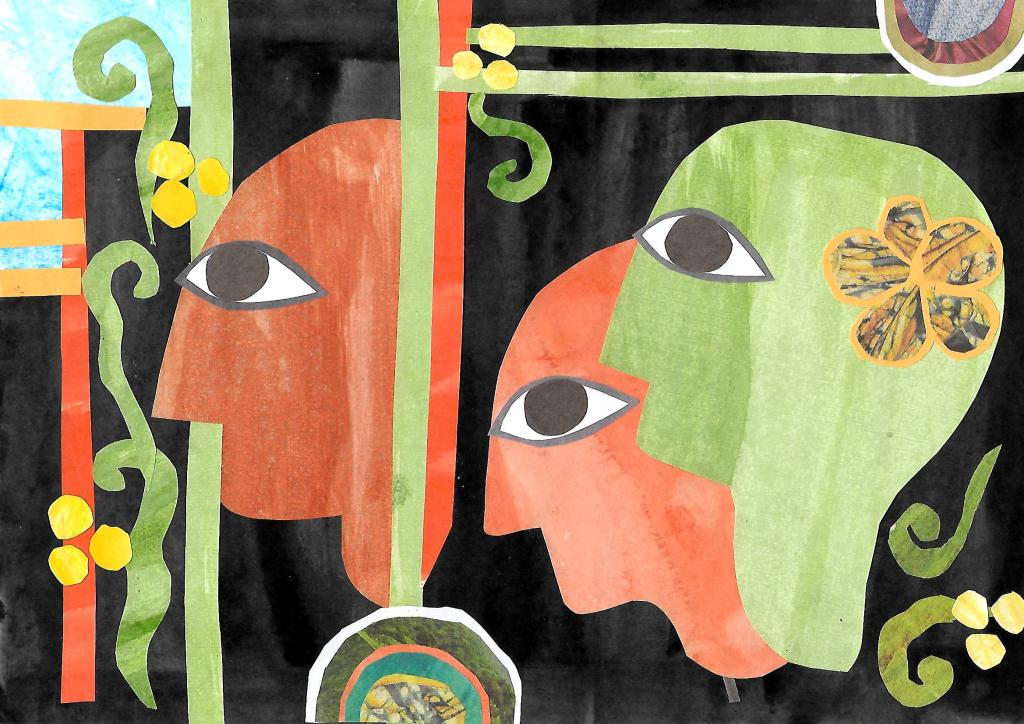
Artwork Source: “…Who Only Stand and Wait” by Vidya Murali
Artist Statement: I love cutting up shapes in paper and creating pictures. I start with just a broad idea and let the work create itself. My work generally reflects my current state of mind. It could be happy, thoughtful, or silly !
Vidya Murali is Female, 70 yrs old, art and craft are favourite hobbies. Next to reading and travel. I live in Bengaluru, India. Learn more on her travel blog.
 turningleafjournal.com