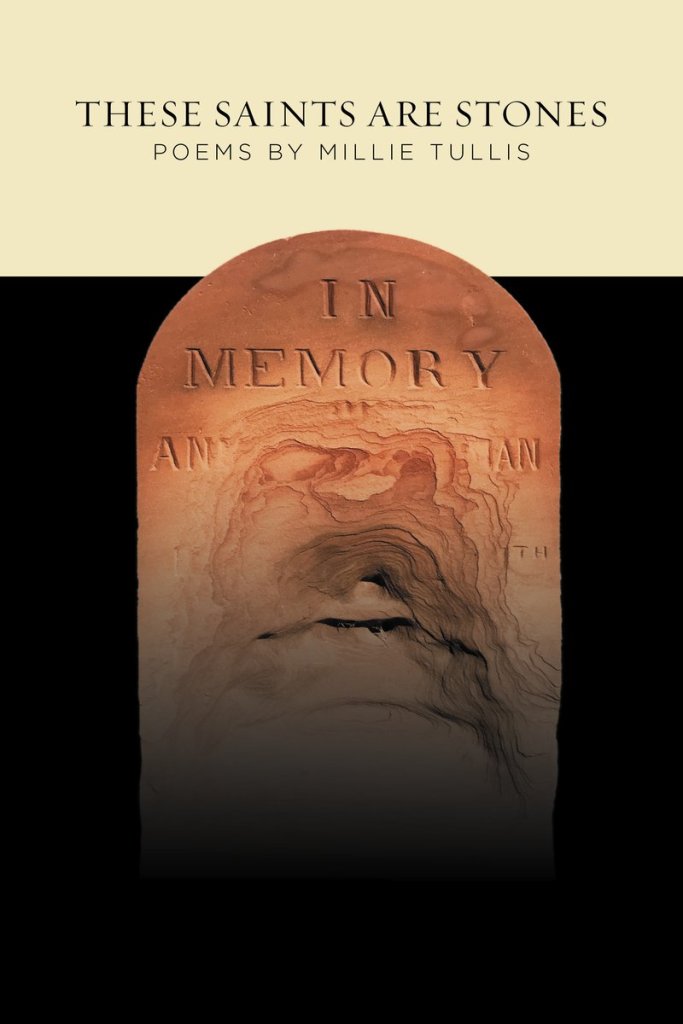
In Millie Tullis’s new poetry collection, These Saints Are Stones, a faithless daughter is haunted by her third-great-grandmother, Martha, a woman who married her stepfather at sixteen and became a sister-wife to her own mother. Tullis cannot stop uncovering details about Martha, who left no written history behind; her silence permeates this collection, which is rife with gaps and fragments, scraps of memory that blend with dreams. Sparse and spare, these poems echo the red desert landscape where the speaker’s ancestors lived and died, where she hunts for graves among the rocks and confronts a past she can never fully know. After all, like a sampling of lace, the cloth of women’s history is more hole than thread.
In March 2026, Volume 1, Issue 1 contributor Millie Tullis, celebrated the release of their debut poetry collection, These Saints Are Stones, published by Signature Press. I was eager to have a conversation with Millie about this collection, especially as someone who also grew up part of the Latter-Day Saint (Mormon) religion and feels haunted by family history. Tullis brings research and years of obsession to their work, and shares some of that process with us in this interview, as well as ideas about grounding both the reader and the self as a writer within our work.
::
Megan Eralie-Henriques: After my first read-through of These Saints Are Stones, I felt most struck by the depth of research and life-long study you’ve poured into this project. Additionally, I’ve been thinking about obsessions in my own work, how there are some subjects I just can’t let go of, even if I don’t quite know what I’m going to do with them. I just know I have to write about them. When you were a child, first visiting your family cemetery in Pinto, did you know right away how significant this visit would be? At what point did you realize this was something you would write about?
Millie Tullis: Thank you for this question! I love that you started with obsessions. As a kid, I did not walk through Pinto Cemetery thinking, “I’m going to come back to this.” But something about that memory and that moment did stick with me. It’s interesting—our obsessions as writers, what grabs and won’t let go. Memories and research often provide starting points for me as a writer. Sometimes, after writing and thinking about a memory, I can see clearly why it mattered to me—why I remember this moment when so many other things are forgotten. Other connections stay a little more mysterious, or onion-like—there can be all these layers of “why” beneath an obsession, a memory. You can keep writing into it over and over and uncovering different things.
I think at the root, I’ve been interested in gender, place, Utah Mormon identity, and family dynamics for a very long time. But the research behind these poems was deliberate. I was obsessed and went digging for what I could find about these women, my ancestors who had shared a husband as mother and daughter. This is also why haunting is a theme in the book, because I was obsessed with finding out what I could, reading and writing into these questions about their lives again and again. It took a very long time for me to put these poems down.
MEH: Your acknowledgements express gratitude for your MFA cohort’s early reading of these poems. I’m wondering if you could tell us more about how this project developed, when it became These Saints Are Stones, or how much your MFA work contributed to this project.
MT: Moving to Virginia for my MFA was a big transition for me. I wasn’t born in northern Utah, but all my memories included living there. Being away from home changed the way I wrote about home in a helpful way (and by “home,” I mean family history, Utah Mormon culture, relationship to place and landscape, all that). I don’t think I saw home more clearly by leaving, but I saw it differently, and so I could write back on it with more than one lens. And workshopping with writers who did not have my same background, context, or cultural baggage was hugely helpful. At first, I was surprised that they were all very interested in my dead Mormon poems, but that gave me some confidence, like, “this could be a project.” Overall, I got very lucky with my MFA cohort and my mentors—I had a really, really wonderful MFA experience.
MEH: I’ve also found it really helpful to share my work with readers who have little to no contextual information about the LDS-sphere, but at first that felt kind of scary. I think there are aspects of every writer’s work that causes them to think “no one will understand this” or even “no one is going to care about this.” What would you say to someone who is feeling those kinds of internal criticisms, with writing or publishing?
MT: Yes, I used to think: this is a strange little poem—is it good-strange? Or is it just an exercise? And sometimes you need someone else to respond to it to help you feel that out. But time has given me more confidence in feeling out what I want a poem to be (though my process of revising, of figuring out what a poem is up to, is slow.) I still benefit from my writing community and a reader’s response, but I also trust myself. I trust myself more than I did as a younger writer. If I really think something is interesting, someone else will too.
Not everyone is a reader for every book, and that is also okay. I love Lydia Davis, who can be sort of relentless in her writing style. Davis said, “A reader can throw his or her hands up and say, that’s enough, and that’s OK; I write it the way I want to write it.” The longer I’ve written, the more clearly I understand what I like to read, how I want to write poems, how I want to write this poem. My advice to a writer struggling with internal criticism would be to read more and write more; notice what you love to read, in terms of content, style, voice, anything, and write work you would love to read. And hopefully it’s also always an evolving target—you read new things and write in new ways, and your obsessions evolve too.
MEH: Your poems titled “Reenactment” describe a quintessential Mormon youth experience: Trek. A literal reenactment of the Mormon Pioneers crossing the plains from Illinois to Utah, typically in a desert or forest setting. When I went, I was one of the unlucky few who didn’t have a pioneer ancestor to connect with, but you did. I’m wondering what your relationship to Martha was like at this point in your life. What did living in her shoes for four days teach you about her? What did you know then?
MT: You pointed out something this poem touches on that I think is interesting. There is the kind of “elite” aura that can come with being a descendant of an early Mormon pioneer in a Mormon Utah cultural context. I can’t speak to this as an absolutely universal Utah Mormon experience, but it was something I was aware of as a kid in Utah. Because family history is sacred—literally sacred, members do redeeming work for their dead family members in the temple—there was a lot of pride in coming from those early converts who suffered so much to get here. If you go to any Daughters of Utah Pioneers Museum in Utah, you can see how highly that identity is valued. Anything belonging to a pioneer is worth preserving, because pioneers are so precious in cultural memory, identity, and family narratives. And that was something I thought about with these poems too: is this work sacred or profane? Maybe it’s both.
Trek was also designed to be a sacred experience. It is also very much about that pioneer suffering and historical memory. Everyone in your company is assigned the name of a historical person. You wear their name, and you wear historical-ish pioneer clothes. In the first “Reenactment” poem, I describe how “we good / girls / pushed and pulled / handcarts” with
          flour sack
          babies on
          our hips
          long skirts
          matching
          pale bonnets
          we sewed with
          our mothers
You push/pull a handcart on the trail for days. You eat food by a campfire. You learn your pioneer’s story (or, if it’s not quite a story, you learn the facts about their life). At various points during the Trek, people take turns getting up and telling those stories, speaking as the historical person, describing their difficult trek and their faith. Some of the historical people die on the trail, and that’s part of the story we’d tell about them. While I hadn’t thought about it as a reenactment at the time, that’s an important part of what it is. A historical reenactment is also a kind of haunting—an obsession with a narrative from the past, running through it again and again.
I wish I remembered more about the Treks I went on, but I do remember that me and my family members were cast as our ancestors. I wish I could remember, truthfully, if I was Martha or one of her sisters. I think I was Martha, and went with that in the poem, but I can’t be certain. But I also think the fact that I can’t remember makes sense—I memorized a few facts, but I knew so little about her life and her story. She was a name on my chest, but not a real person in my imagination and memory.
MEH: For readers who didn’t grow up within the Mormon-sphere, what is important for them to understand before reading your book? Is there anything you want to make sure they have the context for?
MT: Giving context was something I struggled with when writing these poems, and something that I thought about through each version of the book. I think it’s especially tricky because Mormon history, culture, and theology is complex, and because it has changed so much. The Mormonism I grew up in during the 90s was so different than Martha’s experience with her faith. If I were growing up in the church now, it would be a different experience still. And I think the history is fascinating, but I never wanted to get caught up trying to fill in all this context for a reader. A poem isn’t the place to paint all the history and background. Poems are up to something else.
That was a tricky balance at some points in the book—how much I needed to ground a reader. That also was a factor for me in ordering these poems. Martha’s marriage dynamic was so strange and so hard to understand, so it needs comes in early, and clearly. The second poem, “After,” ends on Martha (though she is unnamed):
            No one is named
            for my grandfather’s great grandmother,

            a pioneer girl
            who married

            her mother’s husband
            at sixteen.

            Who delivered him
            twelve children.
Diction was also an important element for these poems—I tried to speak clearly and concisely, with very simple diction, in order to let the strangeness, the complexity, seep through plain language. “After Pinto Cemetery,” reflect this dynamic in the work. It begins, “When I call my husband about the graves / it’s all clarifying relationships” and ends:
           I crave simple sentences. But
           confuse
			           mother
		           father		husband
           daughter	   sister		wife.
MEH: You talk about ways you’ve worked to ground the reader in your work. How do you ground yourself as the writer? Do you have any writing habits or routines that help you get into the work?
MT: For me at least, writing is a weird mix of seeking solitude and seeking community. Community helps me feel rooted, motivated, and seen. I get energy from what my friends are working on and writing with others has often helped me out of a writer’s block. I also think solitude is important—following your own specific interests, questions, and obsessions. People support me in that pursuit, but I always feel like the sole primary investigator. You’ll have readers, but I think you should also like making it for yourself, by yourself. Both friendship and solitude have made a better writer.
Millie Tullis is a poet, editor, and researcher from northern Utah. She holds an MFA from George Mason University and an MA in American Studies & Folklore from Utah State University. Her poetry has been published in Dialogist, Sugar House Review, Cimarron Review, Dialogue, Ninth Letter, and elsewhere. Her digital micro-chapbook, Dream With Teeth, was published by Ghost City Press in 2023. Her research has won awards from the Utah Historical Society, the Folklore Society of Utah, and the American Folklore Society. She is the editor-in-chief of Exponent II.
More from Spring 2026
 turningleafjournal.com
You must be logged in to post a comment.